
Master the Civil Services Exam: The Ultimate Roadmap for UPSC Physics Optional Preparation
Choosing the right optional subject is one of the most critical decisions an IAS aspirant faces, as it accounts for a massive 500 marks in the UPSC Mains exam. For individuals with a solid background in engineering, mathematics, or physics, launching a structured UPSC Physics Optional Preparation strategy offers a highly predictable path to scoring well above 300 marks. Unlike humanities subjects where marking can be subjective, physics is an exact science where correct derivations, clean circuit diagrams, and accurate numerical answers guarantee maximum marks. By committing to a rigorous UPSC Physics Optional Preparation routine early in your civil services journey, you can build a massive competitive advantage, streamline your study hours with a static syllabus, and significantly increase your chances of securing a top rank in the final merit list.
At Scitech Study, we specialize in simplifying complex scientific concepts and converting academic knowledge into exam-oriented answers. We understand that cracking the Civil Services Examination requires a completely different approach than clearing university semesters. To help you navigate this demanding landscape, our expert faculty has designed a comprehensive, highly strategic blueprint covering every nuance of the syllabus.
Why Choose Physics as Your UPSC Optional?
Before diving into the specific strategy, it is essential to understand the unique advantages that a scientific subject like physics brings to your overall civil services portfolio:
Absolute Score Objectivity: Examiners use definitive answer keys; if your derivation step is logically sound and your final numerical value is correct, you will receive full marks.
Static Syllabus Stability: Unlike subjects heavily influenced by current affairs, the core laws of physics do not change from year to year. Once you master a topic, it remains prepared forever.
Minimal Competition Overlap: Because it requires a technical background, you compete against a smaller, highly focused pool of serious candidates rather than tens of thousands of applicants.
🌌 Mastering Paper 1: Classical & Macro Physics
Paper 1 consists of highly structured, conceptual modules. Success here relies on your ability to reproduce complex mathematical proofs and apply formulas accurately to numerical problems.
🎯 Mechanics and Special Relativity
This section carries immense weightage. Your UPSC Physics Optional Preparation must prioritize classical mechanics concepts like D’Alembert’s principle, Lagrange’s and Hamiltonian formulations, and central force motion. In Special Relativity, make sure you can effortlessly derive the Lorentz transformations, length contraction, and mass-energy equivalence formulas.
🌊 Waves, Optics, and Thermodynamics
For Optics, focus your practice on interference, diffraction patterns, and polarization mechanisms. Be ready to sketch clean schematics for setups like the Michelson interferometer. In Thermodynamics, master Maxwell’s thermodynamic relations, the laws of blackbody radiation, and statistical distributions (Fermi-Dirac, Bose-Einstein, and Maxwell-Boltzmann).
⚛️ Conquering Paper 2: Modern & Quantum Physics
Paper 2 shifts into the micro-world and digital electronics. This paper is intensely mathematical and rewards absolute precision in abstract thinking.
🔬 Quantum Mechanics and Atomic Physics
Quantum mechanics forms the core of Paper 2. A regular part of your routine should include solving the one-dimensional time-independent Schrodinger equation for various potential barriers, such as a particle in a box. Under Atomic Physics, give extra attention to the Zeeman effect, Stern-Gerlach experiments, and basic nuclear structural models.
Solid State Physics and Electronics
This is widely considered the most high-scoring segment of the entire exam. Ensure your study tracker completely covers the free electron theory of metals, band theory of solids, p-n junction diode characteristics, Operational Amplifiers (Op-Amps), and digital logic gates.
⚙️ A Strategic 4-Step Blueprint for Success
Simply reading through standard reference textbooks will not translate to high marks under intense exam hall pressure. You need a disciplined, step-by-step approach to convert theoretical knowledge into high-scoring answers.
📚 Step 1: Establish Foundational Conceptual Clarity
Begin by aligning your schedule with standard reference books. Rely on trusted texts such as D.S. Mathur for Mechanics, Brijlal & Subrahmanyam for Optics, and Satya Prakash for Quantum Mechanics. Do not skip chapters or look for shortcuts during this primary phase.
📝 Step 2: Create a Dedicated Derivation Notebook
UPSC frequently asks candidates to reproduce lengthy, multi-step proofs. Maintain a separate, highly organized notebook containing only clean, step-by-step derivations for all major theorems. Practice writing these out from memory at least twice a week.
🔢 Step 3: Develop a Daily Numerical Solving Habit
Nearly 30-40% of the question papers consist of numerical problems. Dedicate at least one hour daily to solving math-heavy physics problems. Pay close attention to converting values into correct SI units and avoiding simple computational mistakes.
⏱️ Step 4: Participate in Rigorous Test Series Simulation
The final phase of your UPSC Physics Optional Preparation must involve writing full-length, 3-hour tests under strict exam conditions. This helps train your brain to manage time efficiently, choose the right optional questions to attempt, and handle mental fatigue.
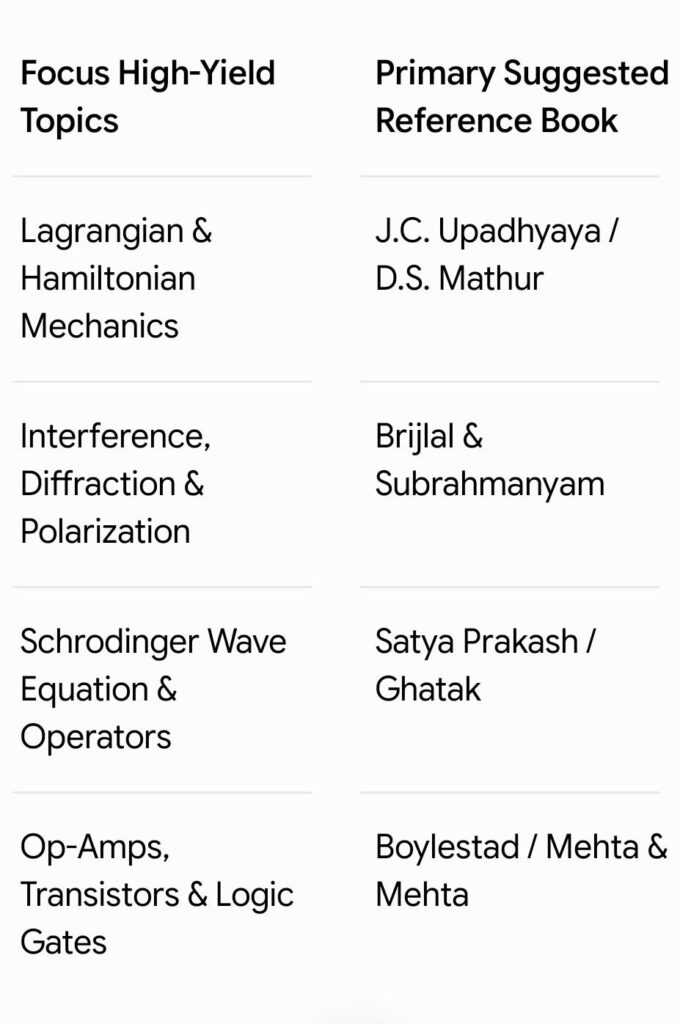
📊 High-Yield Blueprint & Reference Overview
To optimize your daily study hours, prioritize sections that historically yield predictable, high-value questions year after year:
Pro-Tips to Maximize Your Mains Presentation Score
When a UPSC examiner opens your answer sheet, your layout should instantly reflect the precision of a scientist. Follow these formatting guidelines to maximize your marks:
Use Labeled Vector Diagrams: Never draw freehand, messy sketches. Use a pencil and ruler to create crisp, fully labeled diagrams for optical setups or electronic circuits.
State Initial Assumptions Explicitly: Before executing a mathematical derivation, clearly state your boundary conditions and basic physical assumptions (e.g., “Assuming an ideal gas system under adiabatic conditions…”).
Box the Final Answer: Once you compute a numerical solution or finish a core derivation, draw a clean box around your final result and include the correct units. This guides the examiner’s eye directly to your success.
Accelerate Your Journey with Scitech Study
Achieving a 300+ score requires expert guidance, structured study resources, and meticulous answer evaluation. At Scitech Study, we provide a complete learning environment tailored specifically for civil services aspirants. Our programs offer meticulously solved past year question banks, highly customized mock test series, and direct personal mentorship from experienced physics educators.
Do not leave your optional paper to chance or unguided self-study. Build a rock-solid foundation, eliminate your conceptual weaknesses, and secure your spot on the final merit list. Join hands with Scitech Study today and transform your academic potential into a top civil services rank!
Connect With Our Central Coaching Center
Ready to scale up your civil services preparation? Reach out to our academic advisors to enroll in our upcoming dedicated UPSC Physics Optional batches or to order our premium study materials:
📱 Phone / WhatsApp: +91-95605 22202
📧 Official Email: scitechstudyeasy@gmail.com
🌐 Web Portal: www.scitechstudy.com
📍 Delhi Head Office: RZ-2054, TKD Extension, Near Tara Apartment, New Delhi – 110019
📍 Chandigarh Branch: SCO 35, Sector 16D, Chandigarh – 160015



