
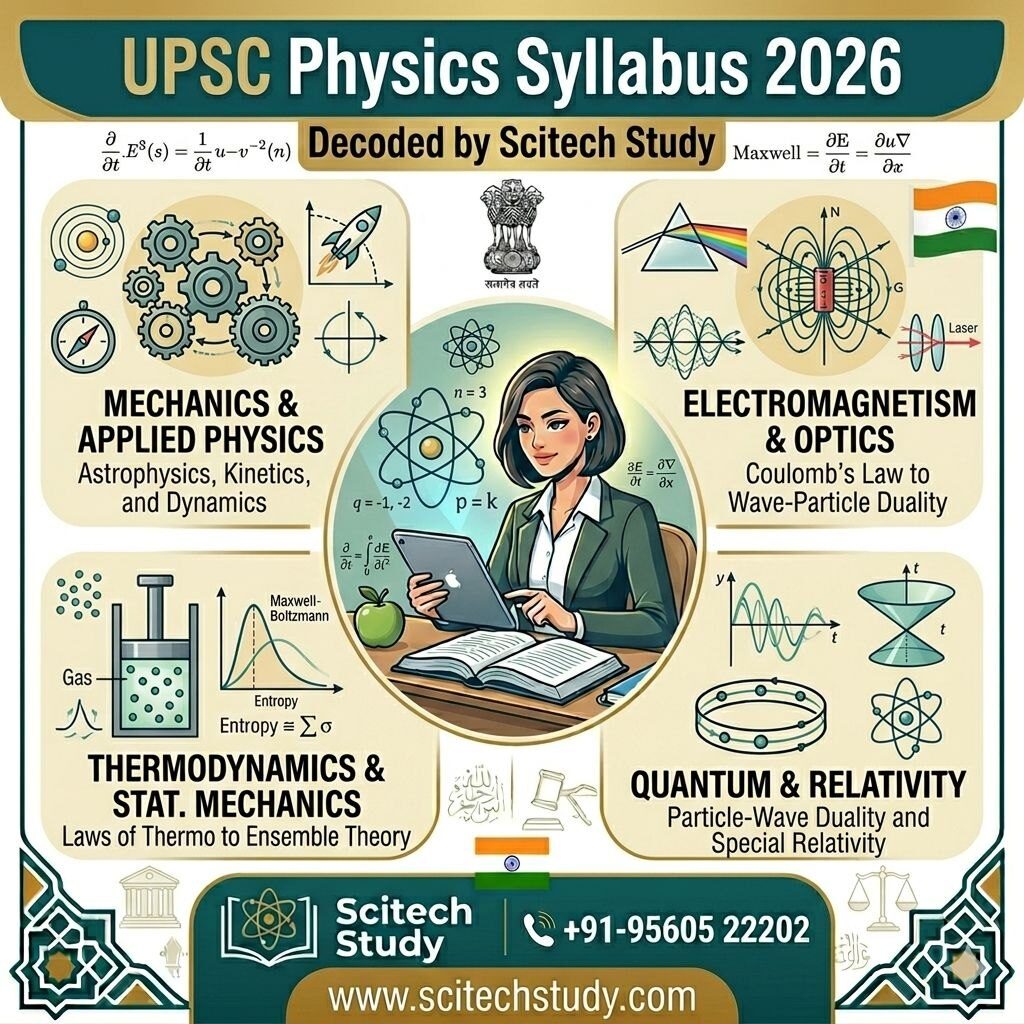
Master the Civil Services Exam: A Strategic Guide to UPSC Physics Syllabus 2026
Embarking on the journey to crack the Civil Services Examination with Physics as your optional subject requires absolute clarity, a structured study plan, and a thorough understanding of the exam pattern. Choosing a core science subject gives you a definitive edge because the syllabus is entirely logical, objective, and highly scoring if your conceptual foundation is strong. To transform this potential into a top rank, your very first step must be a detailed, line-by-line decoding of the official UPSC Physics Syllabus 2026. Deeply analyzing the UPSC Physics Syllabus 2026 helps you map out your preparation schedule, pick the right reference textbooks, and avoid wasting time on topics that fall outside the scope of the civil services exam.
At Scitech Study, we believe that an optional subject shouldn’t just be studied—it must be conquered strategically. Whether you are a graduate fresh out of university or a working professional balancing study hours, this complete breakdown of the 2026 civil services physics curriculum will help you streamline your efforts, optimize your revision cycles, and maximize your final score.
Why Choose Physics Optional in 2026?
Before diving into the technical details, it is important to understand the unique advantages that the current physics curriculum offers to serious civil services aspirants.
High Scoring Potential: Unlike humanities subjects where grading can sometimes be subjective, physics is an exact science. If your derivation is accurate, your diagrams are correct, and your numerical calculation is precise, you are mathematically guaranteed to score near-maximum marks.
Static and Predictable Nature: The core principles of physics do not change with daily current affairs. Once you master the fundamental equations, your preparation remains highly secure and relevant throughout your attempt cycle.
A Solid Advantage for Engineers/Science Graduates: If you have a background in B.Tech, B.Sc, or M.Sc, a significant portion of the syllabus will already feel familiar, drastically cutting down your initial preparation time.
🌌 Detailed Breakdown of Paper 1
Paper 1 of the UPSC Physics Syllabus 2026 primarily covers classical and macro-level physics concepts. The paper is broadly divided into four core structural units, each demanding a fine balance between theoretical proofs and numerical problem-solving.
🪐 1. Mechanics of Particles and Rigid Bodies
This foundational section focuses on the laws governing motion. Key topics include conservation laws, mechanics of a system of particles, rotating frames of reference, centripetal accelerations, and the Coriolis force. Candidates must pay special attention to:
Lagrangian and Hamiltonian Formulations: D’Alembert’s principle, Lagrange’s equations of motion, and Hamiltonian mechanics are highly regular areas of assessment.
Rigid Body Dynamics: Moment of inertia tensor, angular momentum, and Euler’s equations of motion.
🚀 2. Special Relativity
This brief yet high-yielding segment tests your grasp of modern space-time concepts. Focus areas include the Michelson-Morley experiment, Lorentz transformations, length contraction, time dilation, addition of velocities, and mass-energy equivalence (E = mc^2).
🌊 3. Waves and Optics
This unit bridges the gap between mechanical motion and light waves. It explores simple harmonic motion, forced oscillations, resonance, and wave equations. The optics portion demands absolute precision in drawing setup diagrams for:
Interference: Huygens’ principle, Young’s double-slit experiment, Newton’s rings, and Michelson interferometers.
Diffraction: Fraunhofer and Fresnel diffraction, resolving power of telescopes, and diffraction gratings.
Polarization: Production and detection of linearly, circularly, and elliptically polarized light. Laser principles and holography are also integral parts here.
🌡️ 4. Electricity, Magnetism, and Thermodynamics
This section covers classical electrodynamics and heat systems. It deals with Gauss’s law, Laplace and Poisson equations, Ampere’s law, Faraday’s law of induction, and Maxwell’s electromagnetic equations. The thermodynamics part focuses on the laws of thermodynamics, Carnot engines, entropy, Maxwell’s thermodynamic relations, and low-temperature physics.
Comprehensive Guide to Paper 2
Paper 2 shifts the focus entirely toward modern, quantum, and micro-level physics. This paper is intensely mathematical and rewards candidates who have excellent conceptual command over abstract ideas.
🔬 1. Quantum Mechanics
As a centerpiece of the modern UPSC Physics Syllabus 2026, quantum mechanics requires an understanding of the dual nature of matter, Heisenberg’s uncertainty principle, and the foundational wave equations. Essential topics include:
Schrodinger Wave Equation: Time-dependent and time-independent Schrodinger equations.
Applications: Particle in a three-dimensional box, linear harmonic oscillator, and reflection/transmission across rectangular potential barriers.
🔮 2. Atomic and Molecular Physics
This unit focuses on the structural properties of atoms and their spectral lines. Key highlights include the Bohr model, quantum states of an electron, Electron Spin, fine structure of hydrogen atom, Stern-Gerlach experiment, Zeeman effect, and Paschen-Back effect. It also covers the fundamentals of rotational, vibrational, and Raman spectra of diatomic molecules.
🛡️ 3. Nuclear and Particle Physics
Here, candidates explore the building blocks of matter. The syllabus highlights basic nuclear properties (size, binding energy, spin), the liquid drop model, the nuclear shell model, alpha/beta/gamma decay processes, and nuclear reactions (fission and fusion). It also introduces elementary particles, quarks, and the fundamental forces of nature.
🔌 4. Solid State Physics, Devices, and Electronics
This practical section is highly scoring and bridges physics theory with modern engineering. Key topics include:
Solid State Physics: Crystalline structure, Bragg’s law, band theory of solids (metals, insulators, and semiconductors), and superconductivity.
Electronics: Intrinsic and extrinsic semiconductors, p-n junction diodes, transistors, Operational Amplifiers (Op-Amps), and digital electronics (Boolean algebra, logic gates, and microprocessors).
Effective Preparation Blueprint for the 2026 Exam
To comprehensively cover the vast UPSC Physics Syllabus 2026, you need a systematic, multi-phased approach that moves from basic theory to rigorous exam-room practice.
📘 Step 1: Standard Reference Books
Avoid trying to read too many books for a single topic. Stick to classic, standard textbooks such as Mechanics by D.S. Mathur, Optics by Ajoy Ghatak, Quantum Mechanics by H.C. Verma or Ghatak & Lokanathan, and Electronics by B.L. Theraja or Boylestad.
📝 Step 2: Maintain a Dedicated Derivation Diary
Physics papers are heavily loaded with standard derivations. Maintain a separate notebook containing all major derivations from the UPSC Physics Syllabus 2026. Practice writing these steps down without looking, ensuring you state all physical assumptions clearly at the beginning of each proof.
⏱️ Step 3: Integrate Previous Year Questions
Past exam papers are the best indicators of future trends. Always practice answering past questions immediately after finishing a topic to verify if your preparation depth matches the actual demands of the civil services panel.
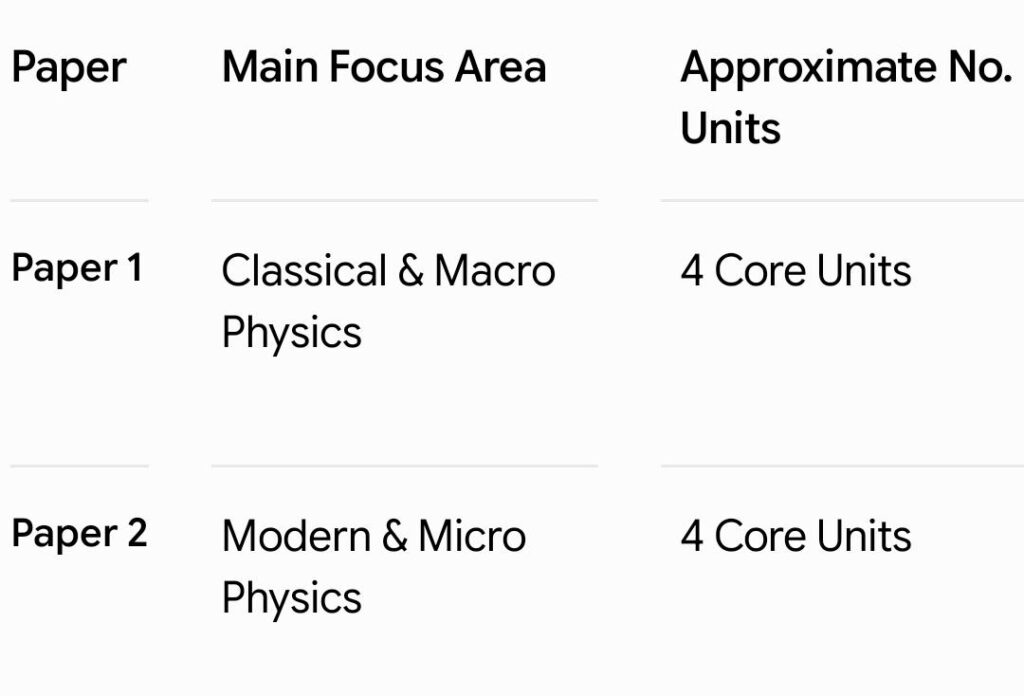
📊 Summary of Syllabus Structure & Marks Distribution
To help you balance your study time effectively between both papers, this table summarizes the core structure of the civil services physics optional examination:
Maximize Your Score with Scitech Study
Navigating the detailed intricacies of the civil services physics exam can be challenging without expert intervention. At Scitech Study, we provide a meticulously designed training ecosystem to help you succeed. Our courses offer comprehensive topic-wise lectures covering the entire updated syllabus, highly accurate solved past papers, and structured mock test series that evaluate your performance down to the smallest mathematical step.
Partner with Scitech Study to eliminate guesswork, master complex physics derivations, and build a clear path toward securing a top rank in the civil services list.
Reach Out to Our Admissions Desk
Ready to accelerate your civil services preparation? Contact our expert academic counselors today to learn more about our upcoming classroom batches, online courses, and specialized physics study materials:
📱 Phone / WhatsApp: +91-95605 22202
📧 Email: scitechstudyeasy@gmail.com
🌐 Official Website: www.scitechstudy.com
📍 Delhi Head Office: RZ-2054, TKD Extension, Near Tara Apartment, New Delhi – 110019
📍 Chandigarh Center: SCO 35, Sector 16D, Chandigarh – 160015



