
Achieve Your Civil Services Dream: The Ultimate Guide to IAS Physics Optional Preparation
Choosing the right optional subject is the single most critical decision in your Civil Services Examination journey, often making the difference between finding your name on the final merit list or missing out entirely. For candidates with a strong background in science or engineering, a structured IAS Physics Optional Preparation strategy provides an unparalleled competitive edge. Unlike humanities subjects where grading can sometimes be subjective, physics is an exact, rule-based science. By committing to a disciplined IAS Physics Optional Preparation roadmap, you enter a domain where scores are purely a reflection of your conceptual accuracy and mathematical precision. This means that if your derivations are flawless and your numerical answers are correct, you are virtually guaranteed to score exceptionally high marks. Integrating past-year analysis and regular answer-writing drills into this technical layout allows you to maximize your overall mains score and secure a top rank in the civil services.
At Scitech Study, we have spent years guiding ambitious science graduates through the intense landscape of the Union Public Service Commission (UPSC) exams. We know that studying physics for a university degree is completely different from presenting it under the high-pressure constraints of the civil services mains. To help you transform your hard work into an outstanding score, our expert faculty has designed a comprehensive learning framework. This definitive guide breaks down the essential steps needed to master this highly rewarding optional subject.
The Core Advantages of Physics as a UPSC Optional
While the syllabus is undeniably extensive and requires rigorous mathematical dedication, the long-term rewards of choosing physics are unmatched by almost any other subject.
Absolute Score Objectivity: Examiners follow a strict, step-based marking key. If your final formula and derivation match the physical laws, you receive full marks without any subjective deductions.
A Completely Static Syllabus: Unlike general studies papers that require you to constantly track dynamic international events or changing government policies, the laws of quantum mechanics and classical thermodynamics remain entirely unchanged.
High Predictability: A major percentage of the question papers consists of direct structural derivations and standard numerical problems that appear with predictable regularity year after year.
Unpacking the Syllabus: Structuring Paper 1 and Paper 2
A successful IAS Physics Optional Preparation plan relies on dividing your study hours systematically between macro-level classical physics and micro-level modern applications.
📐 Paper 1: Classical and Macro-Level Phenomena
Paper 1 focuses primarily on the foundational principles of physical systems. Your preparation modules must build total mastery over:
Mechanics and Special Relativity: Prioritize D’Alembert’s principle, Lagrange’s and Hamiltonian equations, central force motion, Lorentz transformations, and mass-energy equivalence.
Waves and Optics: Focus heavily on Huygens’ principle, interference mechanics (like Michelson’s interferometer), diffraction gratings, and laser physics.
Electricity and Magnetism: Master Gauss’s Law, Laplace and Poisson equations, Biot-Savart law, Maxwell’s electromagnetic equations, and dielectrics.
Thermodynamics and Statistical Physics: Deeply understand the laws of thermodynamics, Maxwell’s thermodynamic relations, blackbody radiation laws, and basic partition functions.
🔬 Paper 2: Quantum Mechanics and Modern Applied Physics
Paper 2 transitions into highly mathematical modern frameworks where absolute conceptual precision is heavily rewarded. Your notes must cover:
Quantum Mechanics: Focus on wave-particle duality, uncertainty principles, Schrodinger’s wave equation, and its applications to a particle in a one-dimensional box.
Atomic and Molecular Physics: Master the Bohr model, Stark effect, Zeeman effect, Stern-Gerlach experiment, and rotational/vibrational spectra.
Nuclear and Particle Physics: Prioritize basic nuclear properties, binding energy, liquid drop and shell models, alpha/beta decay rules, and elementary particle classifications.
Solid State Physics and Electronics: Deeply analyze Bravais lattices, band theory of solids, intrinsic and extrinsic semiconductors, operational amplifiers (Op-Amps), and digital logic gates.
A Disciplined 4-Step Answer-Writing Blueprint
Simply understanding the physical laws in your head will not impress a UPSC evaluator. To convert your knowledge into high scores during your IAS Physics Optional Preparation, you must master the art of technical answer presentation.
The Four-Phase Study Blueprint:
State Core Assumptions Clearly: Before jumping straight into a complex derivation, always write down your starting boundary conditions (e.g., “Assuming an ideal, non-viscous fluid…” or “Under non-relativistic limits…”).
Draw Clean, Labeled Diagrams: Whether illustrating a Michelson interferometer setup or an Op-Amp circuit, use a sharp pencil to draw a neat diagram and label every single variable clearly.
Show Step-by-Step Mathematical Flow: Avoid skipping intermediate mathematical steps during a derivation. Show a clear, logical progression so the examiner can follow your thoughts easily.
Highlight Final Answers with Units: Always draw a clean box around your final mathematical result or numerical value, and make sure to include the correct SI units.
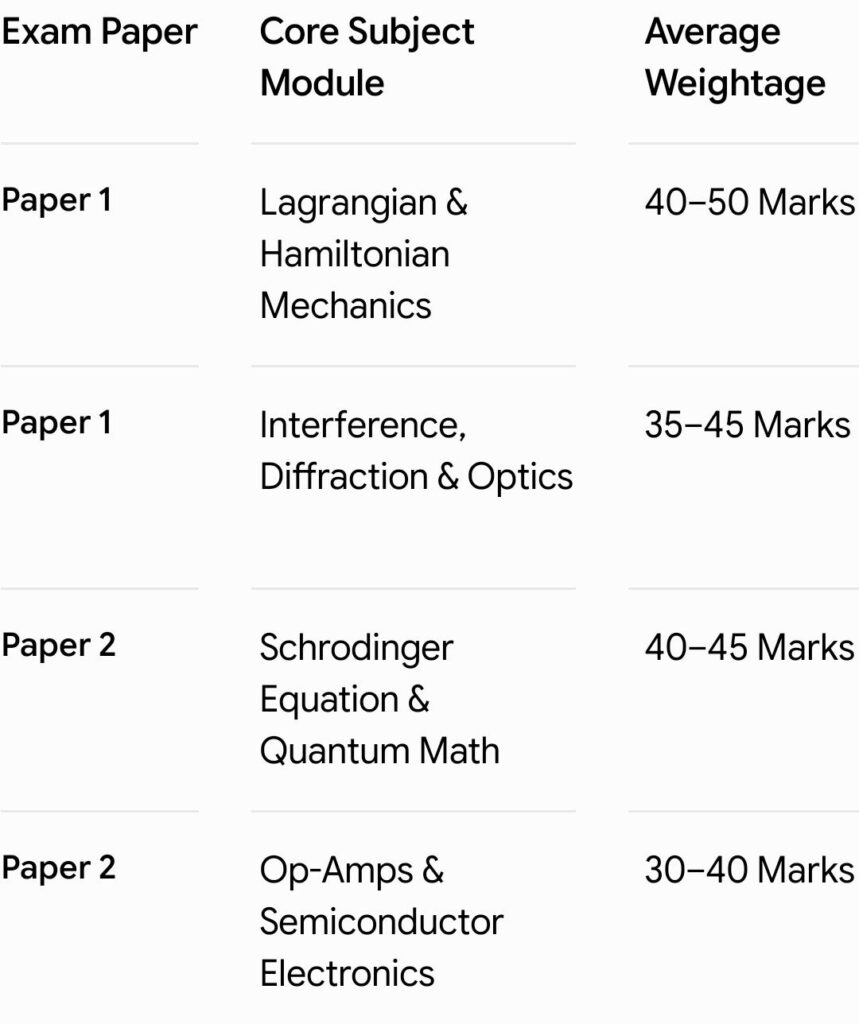
Strategic Mark Allocation Across High-Yield Topics
To help you manage your limited study hours efficiently, our academic council has analyzed past UPSC trends to highlight the high-yielding chapters that deserve your maximum attention:
Critical Mistakes to Avoid During Your Preparation
Many brilliant science students fall short of a top score due to a few common, easily avoidable preparation mistakes:
Neglecting General Studies (GS): Do not get so deeply absorbed in solving beautiful physics problems that you end up neglecting your GS papers or essay practice. Balance is key to clearing the overall cutoff.
Skipping Numerical Practice: Merely reading through derivations in reference books will not give you the speed or accuracy needed to solve complex numerical problems under tight time constraints. You must practice calculations by hand.
Ignoring Part A of the Paper: Candidates often spend all their energy preparing for long 20-mark derivations while ignoring the compulsory short-answer questions in Part A. These short questions are highly scoring and deserve equal attention.
Accelerate Your Journey with Scitech Study
Navigating the vast and intense landscape of the civil services physics optional requires experienced mentorship and a highly structured study ecosystem. At Scitech Study, we provide a complete learning platform featuring comprehensively solved compilations of past UPSC papers, premium printed study material that covers the entirety of the syllabus, and a state-of-the-art mains test series with detailed personalized feedback from veteran professors.
Stop relying on disorganized study routines or scattered reference notes. Join our dedicated optional batches, fix your conceptual blind spots under expert guidance, and turn your technical dedication into a top-ranking civil services career. Contact our admissions team today to book a free diagnostic demo session!
Connect with Our Academic Centers
Ready to take your optional preparation to the highest level? Reach out to our local academic advisors today to check live batch openings, request sample study modules, or explore our flexible enrollment pathways:
📱 Direct Helpline / WhatsApp: +91-95605 22202
📧 Admissions Team Email: scitechstudyeasy@gmail.com
🌐 Official Web Portal: www.scitechstudy.com
📍 Delhi Head Office: RZ-2054, TKD Extension, Near Tara Apartment, New Delhi – 110019
📍 Chandigarh Branch Center: SCO 35, Sector 16D, Chandigarh – 160015



