
Master the Civil Services Exam: The Ultimate Guide to UPSC Physics Handwritten Notes
Cracking the Union Public Service Commission (UPSC) Civil Services Examination requires an exceptional blend of analytical skills, relentless discipline, and highly structured resource management. For aspirants who choose Physics as their optional subject, navigating the vast, deeply mathematical syllabus can feel like an uphill battle without a clear execution roadmap. While standard textbooks provide the foundational concepts, they often lack the tactical, exam-oriented layout needed to write high-scoring answers within strict time constraints. This is exactly where a set of premium, expertly curated UPSC Physics Handwritten Notes becomes your ultimate competitive asset. Accessing a high-yield, comprehensive UPSC Physics Handwritten Notes package allows you to instantly bypass text-heavy volumes, presenting complex derivations, vector diagrams, and boundary-value problems in a scannable, step-by-step format. By anchoring your daily study routine around these tailored digital modules, you can drastically speed up your revision cycles, master the structural representation of mathematical proofs, and build the exact muscle memory required to secure a top-tier score in the mains exam.
At Scitech Study, we understand that conquering the UPSC mains requires a vastly different approach than clear-cut university exams. You aren’t just trying to learn physics; you are training to present elegant, logically flawless solutions under extreme time pressure. To save you thousands of hours of scattered research, our expert faculty has meticulously compiled the definitive study companion. This exhaustive guide details how leveraging structured hand-written notes can revolutionize your optional preparation and boost your place on the final merit list.
The Strategic Advantage of Handwritten Revision Resources
Physics is an exact science, making it one of the most scoring and objective optionals available in the UPSC layout. However, the sheer volume of formulas across Paper 1 and Paper 2 demands a highly functional study system. Relying on professional hand-drawn notes provides three massive strategic benefits:
Flawless Logical Flow: Good handwritten notes map out complex proofs step-by-step, explicitly highlighting the exact algebraic transitions that typed textbooks frequently skip.
Integrated Diagram Templates: These notes provide clean, pre-optimized sketches of experimental setups—such as Michelson interferometers or transistor circuits—giving you ready-made blueprints to replicate on your actual answer sheets.
Rapid Mental Recall: Reading scanned handwriting activates visual memory far more effectively than scanning dense, monotonous rows of typed textbook print, drastically shortening your final revision windows.
Deconstructing Paper 1: Macro-Level Foundations
Paper 1 deals primarily with classical, macro-level physics. To guarantee maximum marks, your UPSC Physics Handwritten Notes must organize this sprawling curriculum into highly structured, high-yield thematic zones:
📐 Mechanics and Special Relativity
This section sets the tone for your Paper 1 score. Your notes must feature crystal-clear, step-by-step breakdowns of D’Alembert’s principle, Lagrangian and Hamiltonian mechanics, rigid body dynamics, and central force motion equations. For Special Relativity, focus heavily on Minkowski diagrams, Lorentz transformations, and mass-energy equivalence proofs.
🌊 Waves, Optics, and Thermodynamics
Optics requires absolute visual precision. Ensure your notes have immaculate diagrams for thin-film interference, Newton’s rings, Fresnel diffraction, and laser population inversion kinetics. For Thermodynamics, prioritize Maxwell’s relations, the laws of thermodynamics, and blackbody radiation derivations.
🔬 Mastering Paper 2: Modern Quantum Realities
Paper 2 transitions into modern quantum mechanics, atomic structures, and solid-state electronics. This paper is intensely mathematical and demands absolute conceptual accuracy.
⚛️ Quantum Mechanics and Atomic Physics
A clean UPSC Physics Handwritten Notes module is indispensable here. It must cleanly illustrate the one-dimensional Schrodinger wave equation and its various boundary applications (such as a particle in a box or a potential barrier). For Atomic Physics, your focus should be on the Zeeman effect, Stern-Gerlach experiments, and basic nuclear shell models.
Solid State Physics and Electronics
Often considered the most high-scoring area of Paper 2, this section requires a clear understanding of crystal structures and circuit design. Your notes must compress band theory, intrinsic/extrinsic semiconductor physics, operational amplifiers (Op-Amps), and digital logic gates into clear, scannable circuit schematics.
⚙️ A Disciplined Method for Active Study
Simply flipping through a PDF passively will not translate into a top score on exam day. To squeeze the absolute maximum value out of your UPSC Physics Handwritten Notes, follow this practical, highly active four-step study routine:
The Four-Phase Study Blueprint:
Targeted Concept Scanning: Read through the summarized theoretical explanations and assumptions to quickly reactivate your core understanding of a specific topic.
Blind Proof Derivation: Close the notes, take a blank sheet of paper, and attempt to write out the entire mathematical derivation from scratch without checking the steps.
Integrated PYQ Cross-Reference: Immediately match your handwritten practice sheet with actual UPSC previous year questions from that unit to see if your presentation meets the exam criteria.
Warning Margin Notes: Use a red pen to jot down your common mathematical slips or missed assumptions directly in the margins of your notes, creating a personalized warning system.
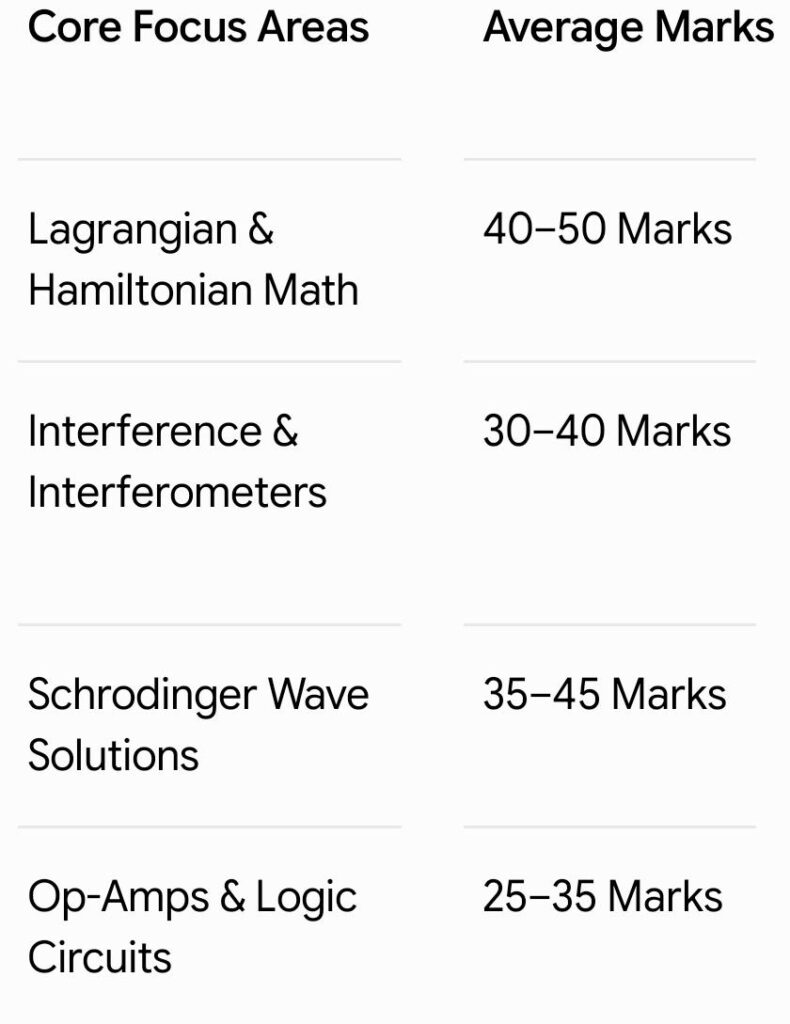
High-Yield Mark Distribution Trends
To help you allocate your limited study hours efficiently during the grueling civil services preparation, our academic council has analyzed past testing trends to map out the chapters that deliver the highest returns.
Practical Answer Writing Secrets from Toppers
When a UPSC examiner opens your physics mains copy, they look for analytical clarity, technical precision, and crisp presentation. Implement these three core tactical adjustments to immediately elevate your answers:
State Assumptions Explicitly: Before executing a complex proof, always write a brief introductory line outlining your constraints (e.g., “Assuming an ideal, non-viscous fluid limit…”). This locks in structural points immediately.
Box Your Final Mathematical Results: Draw a clean, distinct rectangle around your final derived formula or numerical answer, and ensure you include the correct SI units. This makes your copy highly scannable for the examiner.
Use Labeled, Pencil-Drawn Diagrams: Never sketch messy, free-hand diagrams with a pen. Use a sharp pencil and a ruler to draw clean, distinct schematics, labeling every vector, boundary, and component clearly.
Accelerate Your Journey with Scitech Study
Navigating the vast, challenging terrain of the civil services physics optional requires top-tier resources and experienced mentorship. At Scitech Study, we provide an all-inclusive learning ecosystem featuring an extensively updated, expert-curated UPSC Physics Handwritten Notes collection, a rigorous test series that perfectly replicates the mains evaluation standards, and interactive, face-to-face doubt clearing sessions with seasoned physics mentors.
Stop wasting your precious time filtering through unorganized reference books or scattered digital files. Join our dedicated optional batches, eliminate your conceptual weak spots under expert guidance, and turn your academic dedication into a top-ranking civil services rank. Contact our admissions desk today to access our premium study modules!
Connect with Our Academic Centers
Ready to take your civil services physics preparation to the highest level? Reach out to our academic advisors today to check live batch timings, download sample note booklets, or explore our flexible enrollment options:
📱 Direct Helpline / WhatsApp: +91-95605 22202
📧 Admissions Team Email: scitechstudyeasy@gmail.com
🌐 Official Web Portal: www.scitechstudy.com
📍 Delhi Corporate Headquarters: RZ-2054, TKD Extension, Near Tara Apartment, New Delhi – 110019
📍 Chandigarh Learning Center: SCO 35, Sector 16D, Chandigarh – 160015



