
Master the Art of Presentation: The Ultimate Guide to UPSC Physics Optional Answer Writing
Cracking the civil services examination demands a unique combination of deep subject mastery and flawless execution on paper. For civil services aspirants who select physics as their specialized subject, the potential to score exceptionally high is immense due to the absolute clarity and objective nature of science evaluation. However, simply knowing the equations or understanding the physical phenomena is only half the battle won in a highly competitive space. To transform your technical knowledge into top-tier scores that catch the evaluator’s eye, you must master the specific rules of UPSC Physics Optional Answer Writing. Engaging in structured, consistent UPSC Physics Optional Answer Writing practice forces you to transition from an academic style of writing to a highly professional, scannable format designed to score maximum points under strict time limits. By refining your presentation—balancing clean derivations with crisp physical explanations—you ensure that your answer sheets stand out as highly authoritative, helping you claim your rightful spot on the final civil services merit list.
At Scitech Study, we have spent years guiding ambitious aspirants through the intricate demands of the civil services optional landscape. We know that a brilliant physicist can easily lose valuable marks if their presentation lacks structure or fails to highlight the core physical principles behind a mathematical proof. To help you structure your exam papers efficiently, our veteran faculty has decoded the precise parameters used by evaluators to grade technical scripts. This detailed handbook lays down the ultimate blueprint to elevate your presentation style and secure an outstanding score.
The Core Importance of Structuring Technical Answers
Unlike humanities subjects where arguments are open to interpretation, physics is an exact science with a highly predictable marking pattern. Evaluators use a strict step-marking system, which gives well-prepared candidates a major competitive edge.
Step-Marking Security: Even if you make a minor calculation mistake at the very end of a long derivation, a properly structured layout ensures you retain 80% to 90% of the step marks.
Ease of Evaluation: Examiners read hundreds of scripts; making your final answers, vector diagrams, and boundary assumptions instantly scannable minimizes their grading effort and naturally boosts your score.
Effective Time Control: Using a standardized framework prevents you from over-explaining simple concepts, leaving you with plenty of time to tackle complex multi-stage numerical problems.
The Anatomy of a High-Scoring Physics Answer
A winning script requires a perfect balance of text, mathematics, and diagrams. Every long-form answer you draft during your UPSC Physics Optional Answer Writing sessions should follow a clear three-tiered structure.
📝 1. The Contextual Introduction
Never jump straight into writing out equations. Start your answer with a brief two-line introduction that clearly states the core physical law or principle you are applying (e.g., “According to D’Alembert’s principle of virtual work…”). Explicitly write down your baseline assumptions, such as “assuming an ideal, non-viscous fluid under non-relativistic limits.”
📐 2. The Derivation and Visual Setup
This is the core mathematical engine of your answer. Keep your derivation steps clean, logical, and continuous.
Isolate Key Steps: Avoid skipping major mathematical transformations; instead, write brief text notes between equations to explain what you are doing (e.g., “Integrating across boundary conditions…”).
Integrate Diagrams Multi-Dimensionally: Never treat a diagram as an afterthought. Use a sharp pencil to draw clean, labeled vector fields, coordinate systems, or circuit layouts right next to your text setup.
🏁 3. The Physical Conclusion and Application
A stellar response always concludes with a brief physical interpretation of the final mathematical result. Draw a clean box around your final equation or numerical value, make sure to include the proper SI units, and write a quick closing sentence explaining its real-world physical meaning or modern application.
Handling Derivations vs. Numerical Problems
UPSC Paper 1 and Paper 2 feature an intense mix of theoretical derivations and complex numerical problems. Your approach must adapt fluidly to these two distinct question formats.
🔮 Strategy for Advanced Derivations
When deriving advanced equations—such as the Lorentz transformations, Maxwell’s relations, or the one-dimensional Schrodinger wave equation—your focus must be on structural completeness. Examiners penalize papers that skip from the starting setup directly to the final result without showing the intermediate calculus or coordinate transitions.
🔢 Strategy for Analytical Numerical Problems
Numerical problems require total arithmetic precision. To protect your score from simple calculation errors, use this disciplined workflow:
List Given Data: Write out all provided values at the very top, converting them immediately into standard SI units.
State the Governing Formula: Explicitly write down the fundamental formula you intend to use before plugging in numbers.
Sanity-Check the Final Units: Do a quick dimensional check to verify that your final calculated value matches the units of the requested physical property.
High-Yield Focus Blueprint Across Both Papers
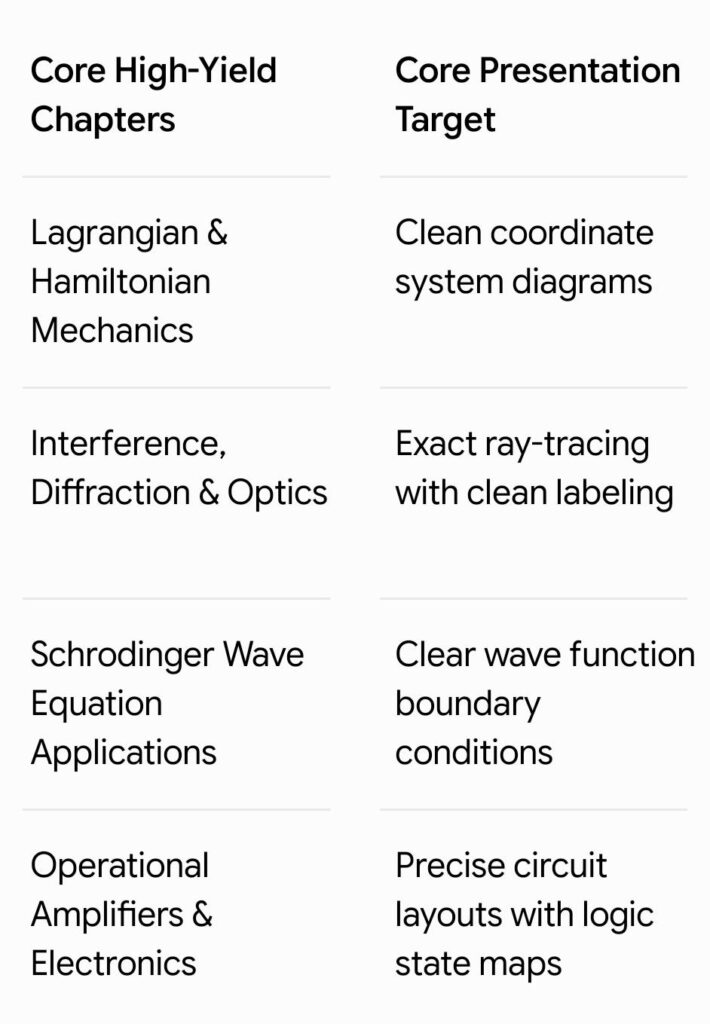
To ensure your UPSC Physics Optional Answer Writing sessions focus on high-return topics, our academic council has analyzed historical trends to map out the chapters that consistently feature high-weightage questions:
Common Traps to Avoid During Practice Sessions
Even highly knowledgeable candidates can miss out on top marks by falling into easily avoidable formatting traps. Keep these three structural warnings in mind during your daily practice:
Avoid Chaotic Layouts: Do not squeeze equations into narrow margins or scribble corrections over mistakes. If you make an error, draw a single clean line through it and rewrite the step neatly.
Do Not Forget to Define Variables: The first time you introduce a symbol in an equation (such as \psi or \eta), write a quick note clarifying exactly what it represents (e.g., “where \psi denotes the spatial wave function”).
Manage Your Space Wisely: UPSC provides fixed Question-cum-Answer Booklets (QABs) with a set number of pages per question. Practicing within bounded text spaces is critical to ensure you do not run out of room mid-derivation.
Maximize Your UPSC Score with Scitech Study
Navigating the deep mathematical landscapes of the physics optional requires systematic practice and insightful, seasoned mentorship. At Scitech Study, we provide an intensive learning framework featuring an expert-guided UPSC Physics Optional Answer Writing program, meticulously solved past-year answer keys, and highly personalized, line-by-line script evaluations with veteran civil services mentors.
Stop leaving your mains marks to unguided practice routines or unstructured study templates. Join our dedicated optional batches, fix your structural presentation issues under expert guidance, and turn your technical knowledge into an extraordinary civil services rank. Contact our admissions desk today to book a free personal strategy session!
Connect with Our Central Admissions Office
Ready to take your optional preparation to the absolute highest level? Reach out to our academic advisors today to check live batch schedules, explore study modules, or request a seat in our answer review program:
📱 Direct Helpline / WhatsApp: +91-95605 22202
📧 Admissions Helpdesk Email: scitechstudyeasy@gmail.com
🌐 Official Web Portal: www.scitechstudy.com
📍 Delhi Head Office: RZ-2054, TKD Extension, Near Tara Apartment, New Delhi – 110019
📍 Chandigarh Branch Center: SCO 35, Sector 16D, Chandigarh – 160015



