
Maximize Your CSE Rank: The Ultimate Guide to UPSC Physics Optional Mock Test
Choosing Physics as your optional subject for the UPSC Civil Services Examination is a highly strategic decision that can dramatically boost your final merit ranking. Because physics is an exact science with a static syllabus, it offers an unparalleled advantage: absolute predictability and a high scoring potential that humanities subjects rarely match. However, translating your deep theoretical knowledge into a top-tier score under the intense time constraints of the mains exam requires a specialized competitive edge. Enrolling in a rigorous, exam-aligned UPSC Physics Optional Mock Test series is the single most critical step to bridge the gap between understanding concepts and executing them flawlessly on paper. By consistently practicing with a structured UPSC Physics Optional Mock Test, you train your brain to manage the strict 3-hour limit, master the layout of the Question-cum-Answer Booklet (QCAB), eliminate algebraic derivation errors, and perfect the presentation style that UPSC examiners reward with maximum marks.
At Scitech Study, we have spent years guiding ambitious civil services aspirants toward exceptional optional scores. We know that writing a physics paper for a university degree is completely different from tackling it under the high-pressure conditions of the civil services mains. To ensure your hard work transforms into an outstanding rank, our expert faculty has designed a premium evaluation program. This comprehensive guide breaks down how a simulated testing environment can elevate your revision strategy and secure your place on the final merit list.
Why Simulated Mock Tests are Indispensable for Physics
Physics rewards absolute precision, but it also penalizes poor planning. Even the most brilliant minds can struggle if they enter the examination hall without practicing simulated papers.
Mastering the QCAB Layout: UPSC provides limited physical space for each answer. Regular practice teaches you exactly how to scale your derivations, steps, and diagrams to fit within the designated lines without running out of room.
Optimizing Question Selection: Both Paper 1 and Paper 2 offer internal choices. Taking full-length simulation tests trains you to scan the sub-questions rapidly and select the specific sections that maximize your scoring probability.
Eliminating Calculation Fatigue: Solving complex differential equations, tensor calculus, or matrix operations for 3 hours straight is mentally exhausting. Building physical and mental endurance prior to the actual mains exam prevents careless mathematical errors in the final hours.
Unpacking Paper 1: Structural Testing Focus Areas
Paper 1 covers macro-level and classical physics. A data-driven UPSC Physics Optional Mock Test evaluates your conceptual and mathematical grip across several key modules.
Mechanics and Special Relativity: Expect deep testing on D’Alembert’s principle, Lagrange’s and Hamiltonian equations, central force motion, and Lorentz transformations. Your test answers must explicitly show all intermediate mathematical steps.
Waves and Optics: This area requires clean, labeled sketches. Mock exams focus on tracking your presentation of interference setups, Michelson’s interferometers, diffraction gratings, and laser polarization principles.
Electricity, Magnetism, and Thermodynamics: Focus areas include Gauss’s law boundary problems, LC circuits, Maxwell’s electromagnetic field equations, the laws of thermodynamics, and Clausius-Clapeyron derivations.
🔬 Unpacking Paper 2: Advanced Quantum & Applied Physics
Paper 2 shifts into the micro-domain, focusing heavily on modern quantum theories, atomic configurations, and solid-state electronics. This paper is highly mathematical and leaves zero room for vague explanations.
Quantum Mechanics: Simulated tests will rigorously evaluate your handling of the one-dimensional Schrodinger wave equation, its boundary conditions (such as a particle in a box), commutation relations, and angular momentum operators.
Atomic, Molecular, and Nuclear Physics: You will face structured questions regarding the Zeeman effect, Stern-Gerlach experiments, the liquid drop model, magic numbers, and elementary particle conservation laws.
Solid State Physics and Electronics: This section is highly scoring. Mock tests check your accuracy in deriving the band theory of solids, calculating intrinsic semiconductor carrier concentrations, and analyzing operational amplifier (Op-Amp) circuits alongside digital logic gates.
How to Utilize Mock Tests Effectively: A 4-Phase Plan
Simply reading through test solutions passively will not build exam-level execution skills. To unlock the full value of your UPSC Physics Optional Mock Test program, implement this active four-tiered study blueprint:
The Four-Phase Study Blueprint:
Topic-Specific Revision: Complete a thorough, targeted review of a single syllabus module (e.g., Electrostatics) before attempting its corresponding sectional mock paper.
Strictly Timed Execution: Sit in a quiet room, completely remove all books, notes, and mobile devices, and write the full test within an absolute 3-hour countdown.
Comparative Evaluation: Carefully compare your evaluated answer sheets against standard model solutions, noting where you lost marks due to missed assumptions or poorly labeled diagrams.
Error Consolidation: Maintain a dedicated journal to log your algebraic slips, missed boundary conditions, or dimensional errors. Review this log thoroughly before taking your next full-length paper.
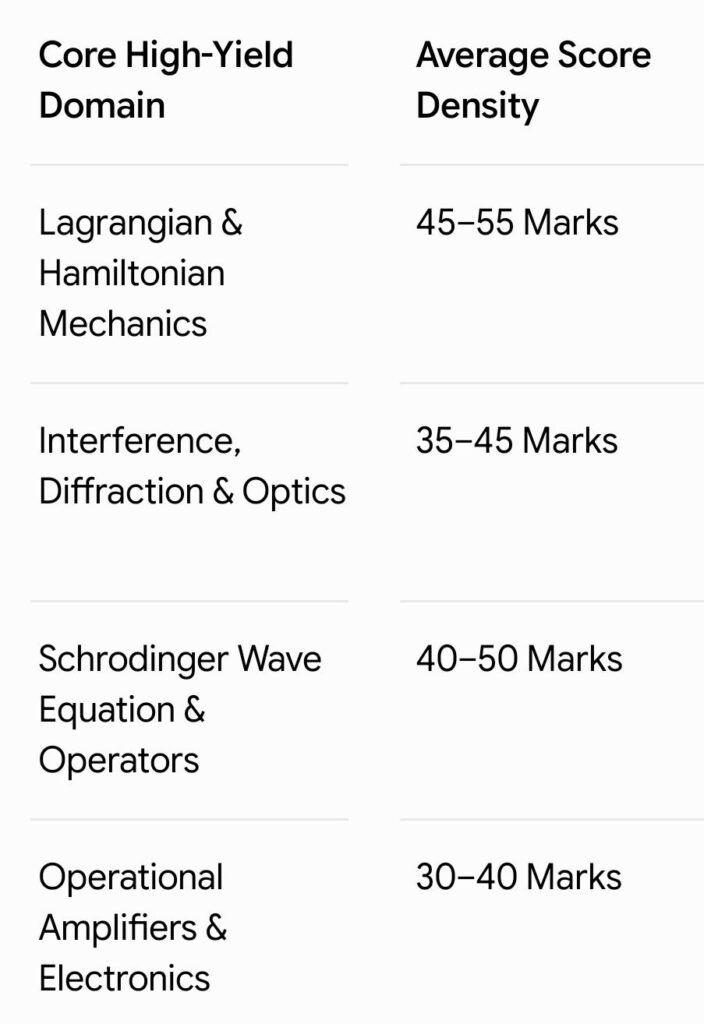
High-Yield Marks Weightage Trends
To help you balance your revision hours effectively, our academic board has analyzed historical civil services papers to map out the core high-yield sections that demand your maximum focus during test practice:
Presentation Secrets to Secure 300+ Marks
When a UPSC examiner opens your physics optional booklet, your presentation style immediately signals your level of mastery. Keep these three core presentation principles in mind during every mock drill:
State Initial Assumptions Explicitly: Before jumping into a complex mathematical proof, clearly state your physical limits (e.g., “Assuming an ideal, non-viscous fluid…” or “Under non-relativistic limits…”).
Draw Labeled, Boxed Diagrams: Never sketch diagrams freehand in a hurry. Use a ruler to draw neat, labeled schematics of optical paths, circuit connections, or potential wells, and frame them inside a clean box.
Highlight the Final Result Clearly: Draw a prominent box around your final mathematical expression or calculated numerical value, and always include the correct SI units to ensure clarity at a glance.
Accelerate Your UPSC Prep with Scitech Study
Navigating the vast mathematical landscapes of the physics optional requires highly experienced mentorship and rigorous feedback. At Scitech Study, we provide an intensive learning ecosystem featuring an expertly curated UPSC Physics Optional Mock Test series, meticulously drafted model answer scripts that serve as perfect revision notes, and highly detailed, one-on-one answer booklet evaluations conducted by veteran physics professors.
Stop relying on unguided routines or unreviewed self-study practices. Join our dedicated testing batches, permanently fix your derivation and presentation blind spots under expert guidance, and transform your hard work into a top civil services rank. Contact our admissions desk today to secure your enrollment!
Connect with Our Central Academic Center
Ready to upgrade your optional preparation strategy? Reach out to our local academic advisors today to check live test schedules, request sample model answer scripts, or explore our flexible enrollment options:
📱 Direct Helpline / WhatsApp: +91-95605 22202
📧 Admissions Team Email: scitechstudyeasy@gmail.com
🌐 Official Web Portal: www.scitechstudy.com
📍 Delhi Head Office: RZ-2054, TKD Extension, Near Tara Apartment, New Delhi – 110019
📍 Chandigarh Branch Office: SCO 35, Sector 16D, Chandigarh – 160015



