
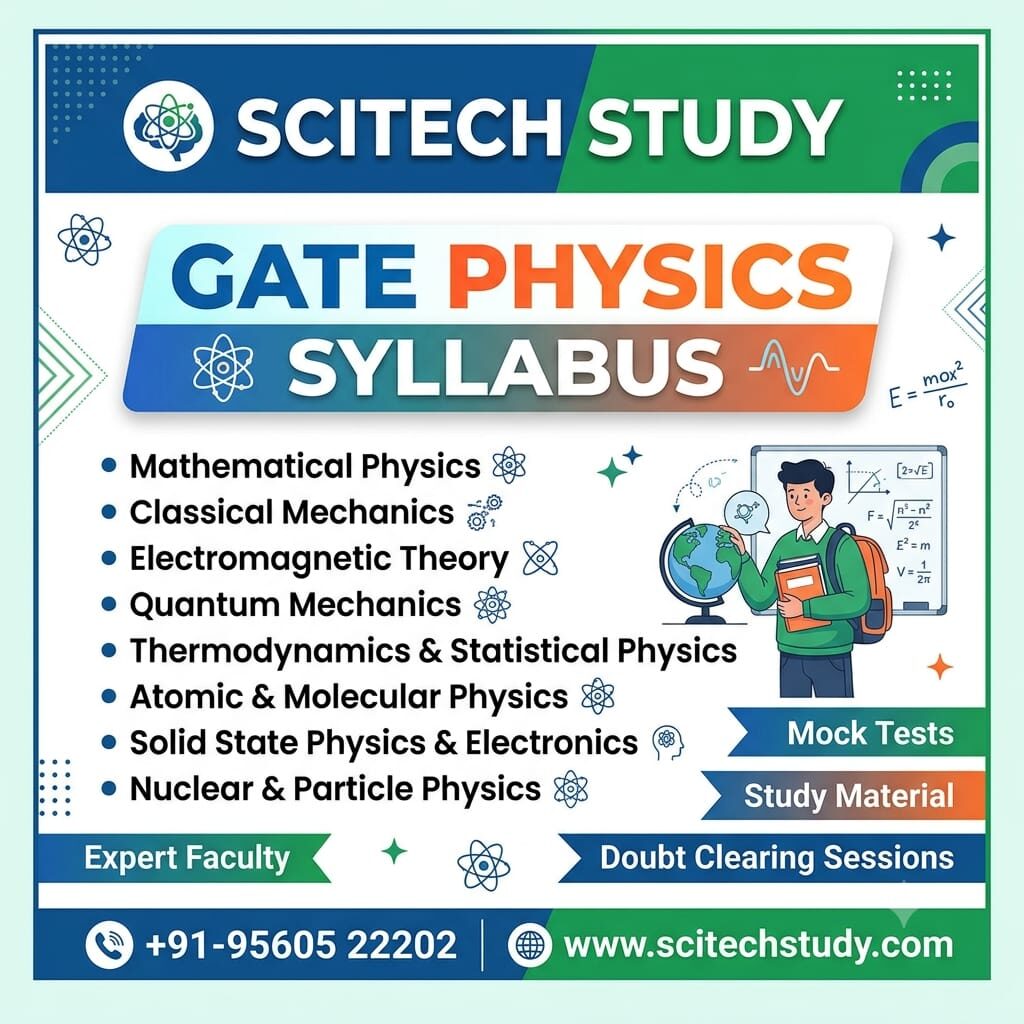
The Ultimate Blueprint: Master the Official GATE Physics Syllabus For Peak Scores
Cracking the Graduate Aptitude Test in Engineering (GATE) in Physical Sciences opens up highly prestigious avenues, including Direct Recruitment into top-tier Public Sector Undertakings (PSUs) and admissions to premier PhD or M.Tech research tracks at elite IITs and IISc. However, because the overarching curriculum blends advanced university-level mathematics with incredibly abstract physical theories, preparing without a defined structural breakdown can quickly stall your progress. To navigate this highly competitive landscape smoothly, developing an intimate, granular understanding of the official GATE Physics Syllabus is the single most vital step you can take today. Thoroughly exploring the GATE Physics Syllabus empowers serious candidates to map out conceptual weight distributions, isolate high-yield derivation frameworks, and build a streamlined revision timetable that balances foundational concepts with advanced analytical problem-solving, turning raw academic effort into flawless test-room execution.
At Scitech Study, we are profoundly dedicated to providing world-class educational coaching, comprehensive printed resources, and personalized digital tracking blueprints for competitive nationwide entrance examinations. Our physics academic panel—consisting of veteran university professors, doctoral scholars, and past national toppers—understands that decoding the exact structural boundaries of the GATE Physics Syllabus is the fastest way to maximize your daily study output. This definitive, 1200-word academic guide provides a comprehensive breakdown of the core subject matrix, section-wise mark allocations, essential formula focus zones, and strategic revision loops that make our training program the national benchmark for elite rank generation.
Sectional Architecture and Marks Weight Distribution
The contemporary GATE Physical Sciences paper follows a highly disciplined structure that splits your total assessment across two clear domains. Understanding this division prevents you from misallocating your study intervals.
The examination consists of a single 100-mark paper containing exactly 65 questions to be answered over an uninterrupted 180-minute window. This total weight is structurally split into two mandatory blocks:
General Aptitude (15 Marks): Comprising 10 questions testing verbal, quantitative, spatial, and analytical reasoning.
Core Subject Syllabus (85 Marks): Comprising 55 questions completely centered around the physical sciences.
The questions are delivered via a digital Computer Based Test (CBT) environment and are split into Multiple Choice Questions (MCQs), Multiple Select Questions (MSQs), and Numerical Answer Type (NAT) items. Because NAT items require you to input exact floating-point decimals with an on-screen mouse-clicked calculator and carry zero negative marking, mastering the mathematical modules of the GATE Physics Syllabus provides an absolute competitive edge over peers who guess on multiple-choice items.
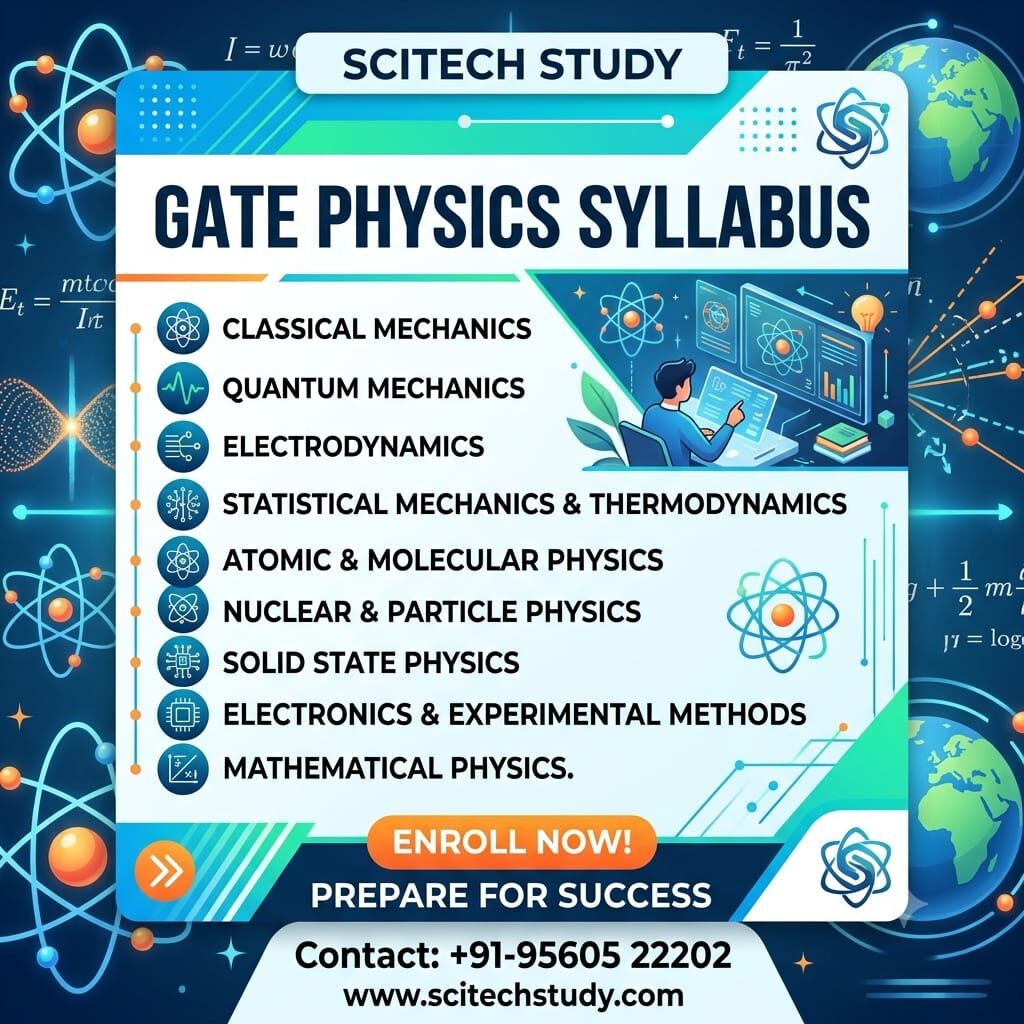
Subject-Wise Dissection of the GATE Physics Syllabus
Our expert panel has systematically organized the comprehensive syllabus into nine fundamental core topics. Each of these components requires a unique mathematical approach and a highly targeted formula collection.
📐 1. Mathematical Physics
Mathematical methods form the absolute computational pipeline for your entire scorecard. You cannot successfully resolve complex quantum or electromagnetic field expressions without master-level control over this introductory segment.
Linear Algebra: Vector spaces, basis vectors, linear independence, matrices, eigenvalues, eigenvectors, and properties of Hermitian and Unitary matrices.
Complex Analysis: Analytic functions, Cauchy-Riemann conditions, Taylor and Laurent series expansions, pole locations, and Cauchy’s Residue Theorem for contour integration.
Differential Equations: First and second-order linear ordinary differential equations, partial differential equations, and special functions (Legendre, Hermite, and Bessel polynomials).
Vector Calculus: Gradient, divergence, curl, line, surface, and volume integrals, Stokes’ and Gauss’ divergence theorems.
⚛️ 2. Classical Mechanics
Classical mechanics bridges Newtonian physics with advanced variational formulations, requiring a sharp spatial visualization capacity.
Newtonian Mechanics: Conservation laws, central forces, Kepler’s problem, and two-body scattering dynamics.
Variational Formulations: Generalized coordinates, Lagrangian and Hamiltonian equations of motion, Hamilton’s principle of least action, and cyclic coordinates.
Advanced Dynamics: Canonical transformations, Poisson brackets, action-angle variables, small oscillations, normal modes, and Special Relativity parameters (Lorentz transformations, relativistic energy-momentum).
🧲 3. Electromagnetic Theory (EMT)
EMT evaluates a student’s capacity to handle advanced vector calculus problems across complex boundary interfaces.
Electrostatics & Magnetostatics: Gauss’s law, Laplace and Poisson equations, boundary value problems, Biot-Savart law, Ampere’s law, and magnetic vector potential.
Maxwell’s Equations: Displacement current, boundary conditions at interfaces, Poynting’s theorem, and electromagnetic energy conservation.
Wave Propagation: Electromagnetic waves in free space, linear dielectrics, reflection, refraction, polarization, and TE/TM rectangular waveguide propagation.
🔬 4. Quantum Mechanics
Quantum mechanics stands as an absolute scoring goldmine within the GATE Physics Syllabus, consistently offering highly structured, mathematically predictable questions in Parts B and C.
Foundational Principles: Wave-particle duality, Schrödinger equation (time-dependent and time-independent), wave functions, probability density, and expectation values.
Bound State Solutions: One-dimensional infinite potential wells, step potentials, transmission across barriers, and the 1D linear harmonic oscillator.
Approximation Techniques: Time-independent non-degenerate and degenerate Perturbation Theory, the Variational Method, and the WKB Approximation for bound states.
Angular Momentum: Commutation relations, spin angular momentum, Pauli spin matrices, and addition of angular momentum.
📊 5. Thermodynamics and Statistical Physics
Statistical mechanics bridges microscopic quantum states with measurable classical thermodynamic variables using clear probability models.
Thermodynamics: Laws of thermodynamics, thermodynamic potentials, Maxwell’s relations, phase equilibria, and the Gibbs phase rule.
Statistical Formulations: Macrostates, microstates, phase space, ensemble theory (microcanonical, canonical, and grand-canonical partition functions).
Quantum Statistics: Ideal Bose and Fermi gases, blackbody radiation laws, Bose-Einstein Condensation, Fermi energy levels, and specific heat of solids.
🎛️ 6. Atomic and Molecular Physics
This section screens for structural clarity regarding the interaction of matter with light fields.
Atomic Systems: Spectra of one- and many-electron atoms, LS and jj coupling schemes, Zeeman effect, Paschen-Back effect, and Stark effect.
Molecular Spectroscopy: Rotational, vibrational, and electronic spectra of diatomic molecules, Raman spectroscopy, and Nuclear Magnetic Resonance (NMR) basics.
💎 7. Solid State Physics
Solid state physics connects atomic arrangements with macroscale electronic and thermal traits.
Crystal Structures: Bravais lattices, Miller indices, Bragg’s law of X-ray diffraction, and reciprocal lattices.
Electronic Traits: Free electron theory, Kronig-Penney model, energy bands in solids, semiconductors (intrinsic and extrinsic), and Superconductivity (Meissner effect, London equations, Type-I and Type-II superconductors).
☢️ 8. Nuclear and Particle Physics
This descriptive yet highly mathematical domain demands a strong grasp of nuclear energy balances and subatomic conservation laws.
Nuclear Traits: Binding energy, semi-empirical mass formula, liquid drop model, and nuclear shell models.
Decay & Interactions: Alpha, beta, and gamma decay mechanics, and fundamental nuclear force interactions.
Particle Physics: Quarks, leptons, gauge bosons, and conservation laws (baryon number, lepton number, strangeness, and isospin).
🔌 9. Electronics
Electronics questions are highly practical, requiring precise evaluation of circuit diagrams and logic networks.
Semiconductor Devices: Diodes, Bipolar Junction Transistors (BJTs), and Field Effect Transistors (FETs).
Operational Amplifiers: Op-Amp characteristics, inverting and non-inverting amplifiers, integrators, and differentiators.
Digital Circuits: Boolean algebra, logic gates, flip-flops, counters, registers, and A/D and D/A converters.
Pattern-Driven Revision Strategy to Conquer the Syllabus
Simply gathering reference books for these nine sections will not translate into a top percentile. To turn the vast contents of the GATE Physics Syllabus into exceptional speed on exam day, you must deploy a structured review cycle:
Build the “Formula-Lineage” Notebook: Dedicate a distinct notebook to high-yield equations from the GATE Physics Syllabus. For instance, write out the exact mathematical steps for WKB quantization or waveguide cutoff frequencies. Review this notebook every morning.
Enforce intermediate Value Precision: When practicing numerical items from the GATE Physics Syllabus, never round off values early in your calculations. Keep numbers stored in your virtual calculator’s memory loop. Rounding early can push your final answer completely outside the designated scoring range.
Execute Full Mock Simulations: Once you finish covering 70% to 80% of the syllabus, sit for full-length 3-hour mock tests precisely during your official exam slot to synchronize your biological clock with the testing software’s interface.
Avoid the Trap of Unverified Public Study Materials
In today’s digital era, community forums and public file-sharing channels are flooded with unverified notes and obsolete question sets. Trying to base your approach to the GATE Physics Syllabus on these uncurated public PDFs can severely compromise your preparation.
Generic physics worksheets often fail to match the specialized numerical thresholds, coordinate orientations, and multi-variable integration steps utilized by IIT examination boards. Furthermore, these unvetted public materials frequently contain critical typographical errors in vector signs, reversed mathematical operators, or completely inaccurate solution keys that can cause you to internalize flawed methods. Relying on a professional, peer-reviewed institutional framework guarantees that every derivation, formula matrix, and solution guide you practice has passed through multi-layered validation checks by certified subject matter specialists.
Why Scitech Study Is the First Choice for Rank Aspirants
Selecting the right training institute to guide your technical milestones requires identifying an academy backed by pristine analytical credentials, modern infrastructure, and deep communal trust:
Elite PhD and Topper Faculty: Our classroom courses and digital study materials are developed exclusively by master educators who hold doctoral credentials in physics and engineering and have cleared these papers with top-tier percentiles.
Pattern-Aligned Test Series Platforms: We provide students with advanced, computer-based mock portals that perfectly replicate the real online testing interface, complete with active virtual calculators and real-time precision feedback built to match the actual exam conditions seamlessly.
Exhaustive Conceptual Materials: We completely replace confusing, text-dense reference volumes with streamlined formula matrices, step-by-step mathematical derivations, and categorized past 10-year question explanations.
Step Into an Advanced Academic Future Today
Securing a distinguished national rank, claiming your monthly institutional stipend, and winning your dream research position at an elite national laboratory demands absolute, calculated dedication. By systematically embedding our premium training curriculum into your daily study schedule, you unlock immediate entry into a high-achieving scientific community engineered to optimize your technical talent.
Stop leaving your critical career milestones, institutional choices, or conceptual clarity to fragmented notebooks or random internet search results. Secure your professional future with verified technical truth. Connect with our student coordination office today, secure your official enrollment slot in our upcoming intensive batches, and fine-tune your approach to the official curriculum with absolute precision!
Connect with Our Central Coordination Office
If you are ready to initiate your batch registration, request an official physical catalog of our printed study material bundles, or book a direct interaction session with our expert physics faculty, reach out to our desk today:
📱 Direct Helpline / WhatsApp Desk: +91-95605 22202
📧 Official Academic Support Email: scitechstudyeasy@gmail.com
🌐 Central Web Portal: www.scitechstudy.com
📍 Regional Campus Headquarters: Scitech Study, East Delhi / Delhi NCR regions, India



