
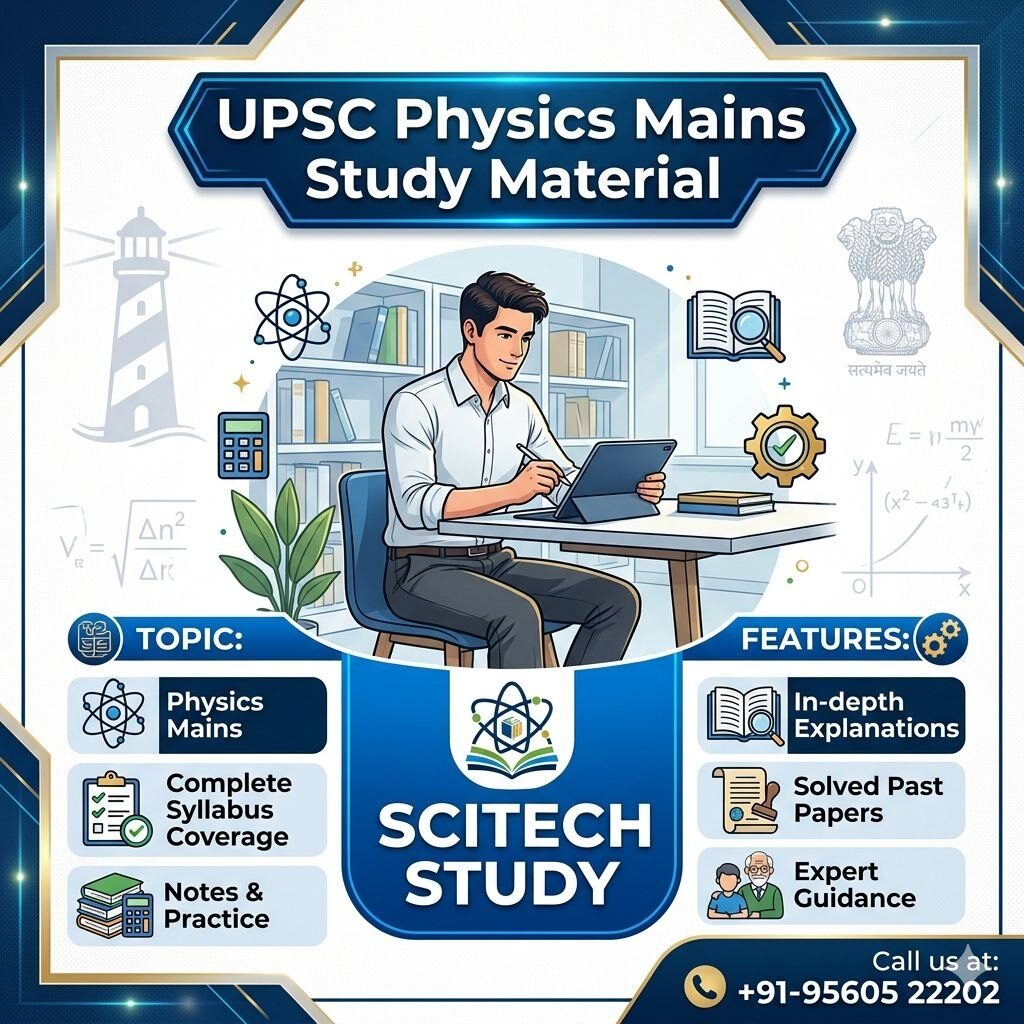
Master the Optional: The Ultimate Guide to UPSC Physics Mains Study Material
Choosing the right optional subject is a critical decision that can make or break your rank in the Union Public Service Commission (UPSC) Civil Services Examination. For aspirants with a background in engineering, physics, or mathematics, opting for Physics can be an incredibly rewarding strategy due to its objective nature, static syllabus, and high scoring potential. However, the sheer depth of the syllabus means that your success depends entirely on having access to structured, comprehensive, and conceptually clear UPSC Physics Mains Study Material. Relying on a scattered approach or outdated notes can lead to wasted attempts, whereas an expertly curated UPSC Physics Mains Study Material acts as a reliable roadmap, streamlining your preparation, breaking down complex derivations, and helping you maximize your marks in both Paper 1 and Paper 2.
At Scitech Study, we understand that mastering a technical optional subject requires more than just reading textbooks; it demands an analytical approach tailored strictly to the current UPSC trend. Our academic team has meticulously structured learning resources that bridge the gap between academic theory and civil services requirements. In this comprehensive guide, we break down the ideal syllabus strategy, essential booklists, and preparation methodologies to help you ace your optional papers.
Why Choose Physics as Your UPSC Optional?
Before diving into the core preparation material, it is vital to understand the structural advantages that Physics offers compared to humanities subjects:
Absolute Objectivity: Unlike subjective papers where marking parameters can vary based on the evaluator’s perspective, Physics answers are absolute. If your derivation is correct and your numerical calculations are accurate, you get near-maximum marks.
Static Syllabus: The laws of nature, quantum mechanics equations, and thermodynamic principles do not change with current affairs. Once you master the core concepts, your preparation remains valid for multiple attempts.
High Scoring Potential: Year after year, top scorers with technical backgrounds secure 300+ marks in Physics, providing a significant competitive advantage in the final merit list.
📚 Paper-wise Breakdown and UPSC Physics Mains Study Material
The UPSC Physics optional syllabus is divided into two distinct papers, each requiring a balance of theoretical concepts, rigorous derivations, and precise numerical problem-solving.
🌌 Paper 1: Macro-Physics and Classical Theories
Paper 1 is highly mathematical and rewards students who have strong spatial and analytical reasoning. The core topics require robust practice of standard derivations and numerical questions.
Mechanics: Focus heavily on D’Alembert’s principle, Lagrange’s and Hamilton’s equations, central force motion, and the special theory of relativity. Standard references include Classical Mechanics by J.C. Upadhyaya.
Waves and Optics: Pay special attention to interference (Michelson interferometer), diffraction (Fraunhofer and Fresnel), and polarization. Optics by Ajoy Ghatak is considered the gold standard here.
Electricity and Magnetism: Maxwell’s equations, Biot-Savart law, and electromagnetic wave propagation in different media form the backbone of this section. Use Introduction to Electrodynamics by David J. Griffiths.
Thermodynamics and Statistical Physics: Master the laws of thermodynamics, blackbody radiation laws, and Fermi-Dirac/Bose-Einstein statistics. Use Thermal Physics by Garg, Bansal, and Ghosh.
🔬 Paper 2: Micro-Physics and Modern Theories
Paper 2 transitions into modern, abstract physics. It requires conceptual clarity to explain non-intuitive quantum and atomic phenomena clearly on paper.
Quantum Mechanics: Focus on the Schrödinger wave equation, particle in a box, tunneling effect, and linear harmonic oscillators. Quantum Mechanics by Nouredine Zettili or H.C. Verma provides excellent conceptual depth.
Atomic and Molecular Physics: Study the Zeeman effect, Paschen-Back effect, and rotational/vibrational spectra of diatomic molecules. Fundamentals of Molecular Spectroscopy by Colin Banwell is highly recommended.
Nuclear and Particle Physics: Memorize the liquid drop model, shell model, alpha/beta decay mechanics, and elementary particle classifications. Use Nuclear Physics by S.B. Patel or D.C. Tayal.
Solid State Physics and Electronics: Master crystal structures, Bragg’s law, band theory of solids, and operational amplifiers (Op-Amps). Refer to Solid State Physics by S.O. Pillai and Principles of Electronics by V.K. Mehta.
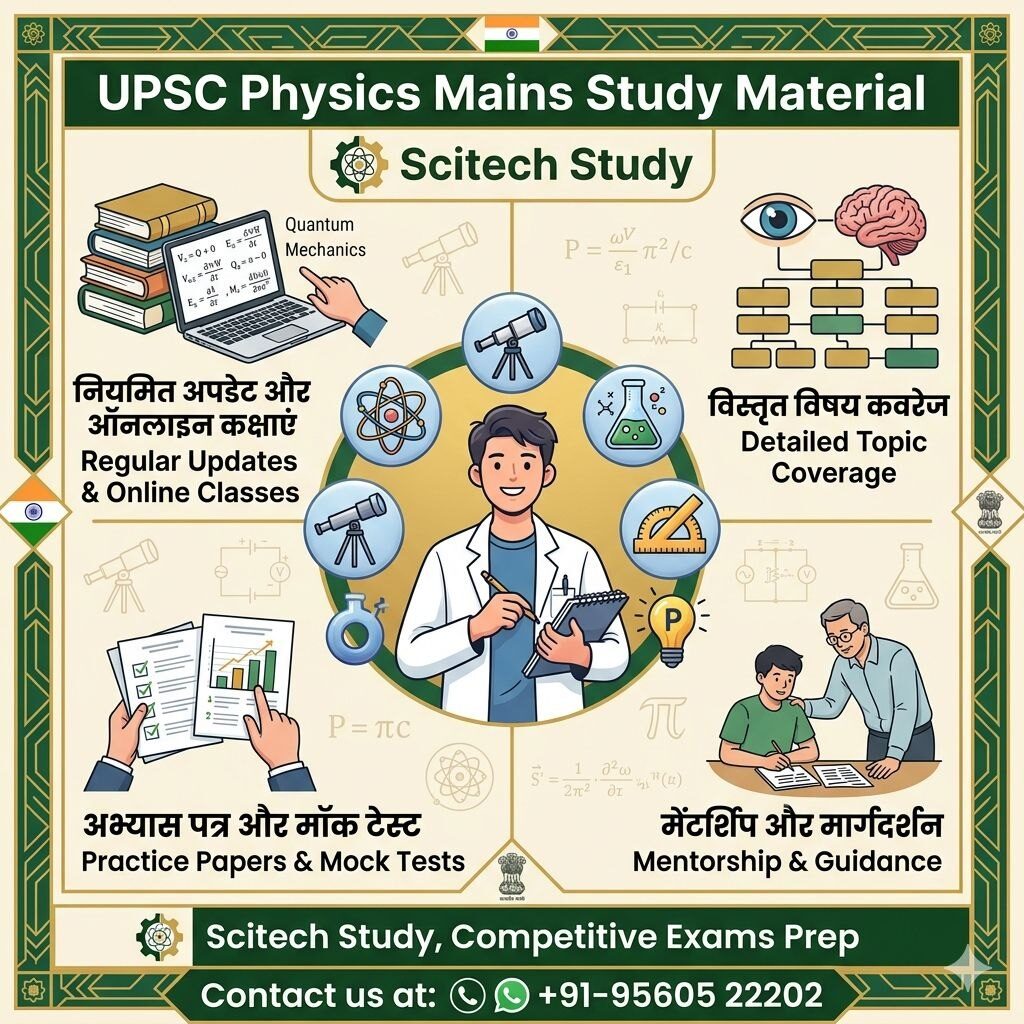
Essential Components of an Effective Study Resource
When selecting or compiling your UPSC Physics Mains Study Material, ensuring it includes specific, targeted components can dramatically accelerate your learning curve:
📐 Step-by-Step Solved Derivations
UPSC frequently repeats standard derivations directly from the syllabus. Your study material must present these derivations linearly, without skipping intermediate mathematical steps, making it easy to memorize and reproduce under exam pressure.
🔢 Topic-wise Classified Numericals
Numericals make up nearly 30% to 40% of the paper. Your UPSC Physics Mains Study Material must contain categorized numerical problems from engineering services and civil services past papers to help you build calculation speed and accuracy.
📋 Integrated Previous Year Questions (PYQs)
Analyzing the past 15–20 years of exam papers reveals a distinct pattern in how questions are framed. High-quality UPSC Physics Mains Study Material seamlessly integrates PYQs at the end of each chapter, allowing you to test your understanding against actual exam standards immediately.
📊 Comparison Matrix: Standard Reference Books vs. Scitech Study Material
While standard textbooks are essential for building a conceptual foundation, they are often too exhaustive and not optimized for a time-bound civil services exam.
How to Maximize Your Output from Physics Study Material
Simply owning high-quality study material won’t guarantee success; your execution strategy matters just as much. Follow these three foundational preparation pillars:
Develop a Formula Handbook: Create a concise formula notebook for every unit. Revision of formulas and constants must be done weekly to avoid errors during numerical calculations.
Practice on UPSC-Style Sheets: Solve numericals and derivations on unruled, white A4 sheets with margins. This trains your brain to manage space efficiently, as UPSC provides a fixed Question-cum-Answer Booklet (QCAB).
Strict Time-Bound Practice: When practicing with your UPSC Physics Mains Study Material, set a timer. A 10-mark question should be finished within 7 minutes, and a 20-mark question within 13–14 minutes.
Achieve Academic Excellence with Scitech Study
Navigating a highly technical optional paper like Physics requires structured guidance, precise study resources, and consistent evaluation. Scitech Study is dedicated to delivering high-yield, deeply researched learning tools designed to help you conquer competitive examinations. By choosing our specialized UPSC Physics Mains Study Material, you eliminate guesswork, bypass the tedious process of manual note-making from multiple heavy textbooks, and gain a clear, concise pathway to scoring 300+ marks.
Don’t let unorganized resources dilute your hard work. Invest your time wisely, study with precision, and build the competitive edge required to make it to the final civil services merit list. Take a definitive step toward your IAS/IPS dream by accessing the premium UPSC Physics Mains Study Material at Scitech Study today!
Contact Scitech Study Today
For detailed inquiries regarding our specialized study materials, classroom programs, distance learning modules, or expert mentorship sessions, feel free to reach out to our central administrative team:
📱 Phone / WhatsApp: +91-95605 22202
📧 Official Email: scitechstudyeasy@gmail.com
🌐 Web Portal: www.scitechstudy.com
📍 Delhi Corporate Center: RZ-2054, TKD Extension, Near Tara Apartment, New Delhi – 110019
📍 Regional Campus Office: SCO 35, Sector 16D, Chandigarh – 160015



