
Crack the Civil Services Exam: The Ultimate Guide to UPSC Physics Notes PDF
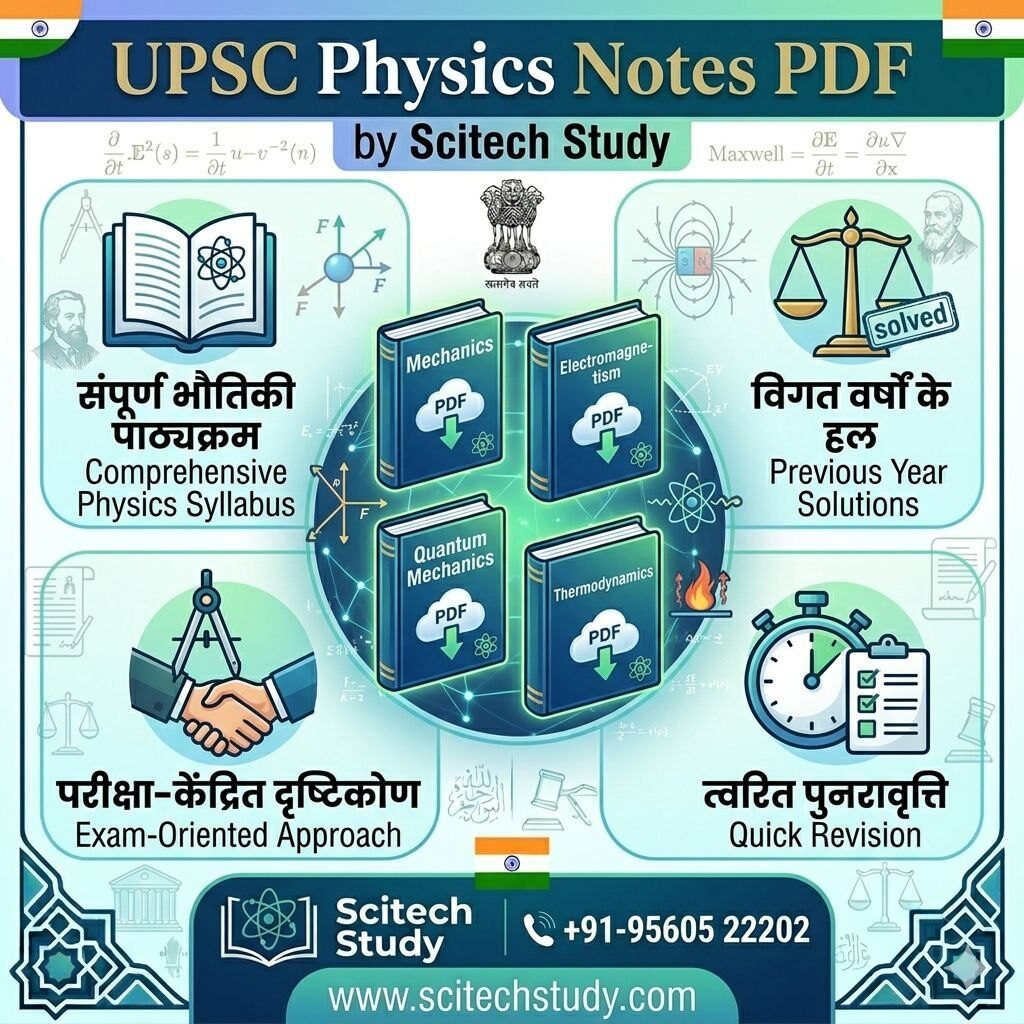
Cracking the Union Public Service Commission (UPSC) Civil Services Examination with Physics as an optional subject demands an exceptional level of conceptual clarity, mathematical precision, and highly structured revision. Because the syllabus is vast, spanning from classical mechanics to advanced quantum mechanics, attempting to revise directly from bulky academic textbooks during the high-pressure exam days is a recipe for overwhelm. To streamline your preparation and build a highly efficient study routine, accessing a well-structured UPSC Physics Notes PDF is an absolute game-changer. A comprehensive UPSC Physics Notes PDF serves as a centralized repository of all critical derivations, core formulas, and labeled circuit diagrams, allowing you to quickly revise high-yield topics and bridge the gap between understanding a concept and writing a top-scoring answer. Integrating these curated digital resources into your daily study schedule ensures you maintain a sharp competitive edge and maximize your optional score.
At Scitech Study, we have spent years guiding civil services aspirants toward success. We know that the key to scoring 300+ marks in the physics optional lies in crisp presentation, accurate mathematical proofs, and well-organized study materials. To help you save precious time and focus entirely on learning, our expert faculty has compiled a premium, highly targeted study series. Here is an in-depth guide on how to effectively utilize digital study resources to transform your optional preparation.
Why Digital Notes are Essential for Physics Optional
Physics is a highly structured, objective science. Unlike humanities subjects where answers can be subjective, physics rewards absolute accuracy.
Rapid Last-Minute Revision: During the short gap between the General Studies papers and the Optional papers, a mobile-friendly UPSC Physics Notes PDF allows you to scan hundreds of equations rapidly.
Centralized Derivations: Good digital resources pull complex step-by-step proofs from multiple standard textbooks (like Kleppner, Griffiths, or Ghatak) into a single, accessible document.
Easy Customization: Digital documents allow you to easily insert screenshots of past year questions or add personal shortcuts right next to the relevant theoretical topics.
🌌 Comprehensive Blueprint of Paper 1 Notes
Paper 1 deals primarily with classical and macro-level phenomena. Your core UPSC Physics Notes PDF must be broken down into clean, manageable segments for these key areas.
🪐 Mechanics and Special Relativity
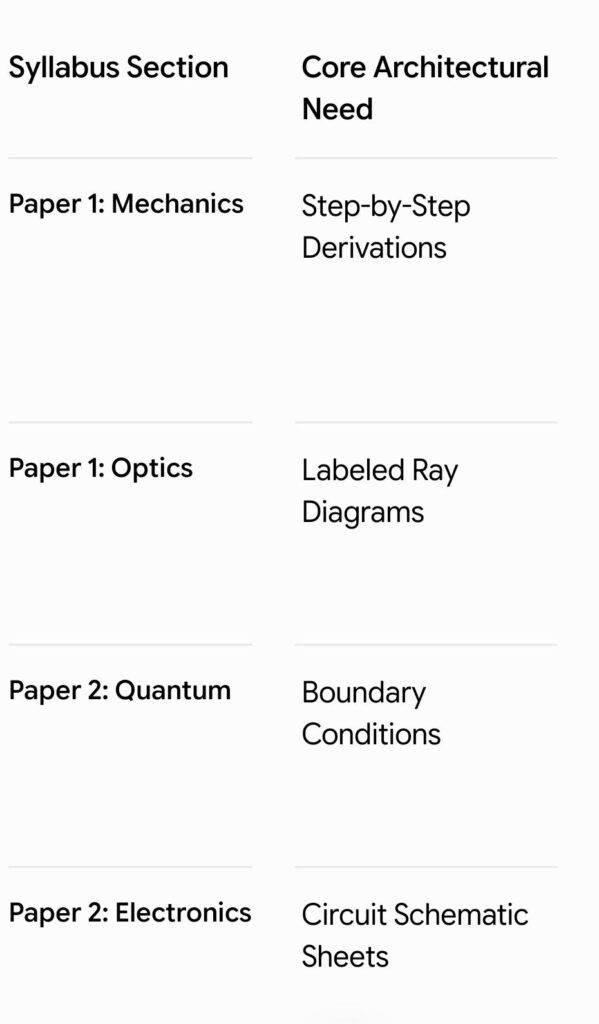
This section forms the foundation of Paper 1. Your study materials should feature clear, step-by-step breakdowns of constraint equations, D’Alembert’s principle, Lagrangian and Hamiltonian formulations, and central force motion. For Special Relativity, ensure your digital notes have dedicated pages for the Lorentz transformation derivations and four-vector mechanics.
🌊 Waves, Optics, and Thermodynamics
Optics requires absolute visual precision. Your notes must highlight the mathematical conditions for interference, diffraction gratings, and the step-by-step working principles of Michelson and Fabry-Perot interferometers. For Thermodynamics, focus on a quick-reference table for Maxwell’s thermodynamic relations and clean derivations of blackbody radiation laws.
🔬 High-Yield Focus Areas for Paper 2 Notes
Paper 2 transitions into modern, micro-level physics, which is heavily mathematical and requires a flawless command over quantum and electronic concepts.
⚛️ Quantum Mechanics and Atomic Physics
A high-quality UPSC Physics Notes PDF will always dedicate substantial space to the application of the Schrodinger wave equation. Make sure you have clear, error-free mathematical sheets for a particle in a one-dimensional box, the linear harmonic oscillator, and the hydrogen atom problem. For atomic physics, focus on clear summaries of the Zeeman effect and vector atom models.
Solid State Physics and Electronics
This is widely considered the most scoring portion of the entire syllabus. Your digital materials should feature crisp, labeled circuit diagrams for Operational Amplifiers (Op-Amps) in various configurations (inverting, non-inverting, integrators), alongside truth tables for digital logic gates and clear equations explaining the band theory of solids.
⚙️ How to Master Your Syllabus Using a PDF Blueprint
Simply downloading files onto your tablet or laptop will not automatically improve your score. You need a disciplined, active study strategy to extract maximum value from a UPSC Physics Notes PDF.
📄 Step 1: Active Reading and Mapping
Open your digital note module alongside the official UPSC syllabus sheet. Mark off each topic as you read through the text, ensuring that no sub-topic or hidden boundary condition is skipped.
✍️ Step 2: Write Out the Derivations
Physics cannot be memorized by just looking at a screen. Use the UPSC Physics Notes PDF as a structural reference guide, close the document, and try to write out the entire mathematical proof from scratch on a blank piece of paper.
📉 Step 3: Extract Micro-Sheets for Revision
As you progress through the comprehensive digital documents, extract core formulas, fundamental constants, and tricky sign conventions into a highly condensed 2-page micro-sheet. This micro-sheet will be your closest companion on the final night before the mains exam.
📊 Structural Breakdown of Ideal Revision Materials
To ensure your study resources are truly effective, verify that they organize complex information into easily scannable visual structures.
Presentation Secrets to Score 300+ Marks
UPSC examiners evaluate thousands of answer sheets. To make your copy stand out instantly, implement these three formatting habits directly derived from top-tier study notes:
State Initial Assumptions: Before starting any long proof, explicitly write down the boundary conditions or physical assumptions (e.g., “Assuming a non-relativistic, collisionless plasma…”).
Enclose Final Values in Boxes: Draw a clean, distinct box around your final mathematical result or numerical answer, and always include the correct SI units.
Integrate Text with Diagrams: Never leave a diagram hanging without textual references. Label axes clearly and refer to your figures directly within your equations (e.g., “As shown in Fig 1.2…”).
Maximize Your Potential with Scitech Study
Navigating the competitive civil services landscape demands access to high-grade, reliable study tools. At Scitech Study, we provide a complete, scientifically designed educational ecosystem. Our meticulously compiled UPSC Physics Notes PDF series filters out the noise from heavy academic volumes, providing you with exact, exam-oriented content that matches the difficulty of recent UPSC trends.
Do not waste months trying to aggregate notes from scattered internet sources. Invest your energy into active practice, perfect your answer presentation, and secure your place on the final merit list. Partner with Scitech Study today and fast-track your journey into the civil services!
Connect With Our Central Coaching Center
Ready to upgrade your optional study materials or enroll in our dedicated guidance programs? Contact our academic mentors directly:
📱 Phone / WhatsApp: +91-95605 22202
📧 Email: scitechstudyeasy@gmail.com
🌐 Official Portal: www.scitechstudy.com
📍 Delhi Head Office: RZ-2054, TKD Extension, Near Tara Apartment, New Delhi – 110019
📍 Chandigarh Center: SCO 35, Sector 16D, Chandigarh – 160015



