
Master the Civil Services Exam: The Ultimate Guide to UPSC Physics Previous Year Questions
Cracking the Civil Services Examination requires a perfect blend of dedication, conceptual clarity, and highly targeted practice. For aspirants who choose Physics as their optional subject, mastering the vast syllabus can feel daunting without the right orientation. One of the most powerful, time-tested tools to streamline your preparation is the systematic analysis of UPSC Physics Previous Year Questions. By deeply engaging with UPSC Physics Previous Year Questions, you gain direct insights into the mind of the paper setter, allowing you to identify recurring themes, understand the expected depth of numerical problems, and decode the subtle shift in weightage between classical mechanics and modern physics over the years. Integrating these papers into your weekly study cycle is not just an option—it is the foundational core of a winning strategy.
At Scitech Study, we have spent years mentoring top-ranking civil services aspirants. We know that studying physics for an academic degree is entirely different from tackling it in a highly competitive civil services environment. To help you transform your hard work into an outstanding score, our expert faculty has compiled, categorized, and solved decades of past papers. Here is a comprehensive roadmap on how to maximize your score using past year papers.
Why Past Year Papers Matter for Physics Optional
Physics is an exact science, which gives optional candidates a distinct advantage: the syllabus is static, structured, and highly scoring if your presentation is structurally correct.
Spotting Recurring Themes: Unlike general studies, core physics topics like the special theory of relativity, LC networks, or the Schrodinger wave equation appear with predictable regularity.
Understanding Numerical Complexity: Past papers show you exactly when a derivation needs a rigorous mathematical treatment versus when a physical explanation suffices.
Perfecting Answer Structuring: Reviewing past exam sheets helps you understand how to split your answers between neat, labeled diagrams, step-by-step derivations, and short final conclusions.
📚 Categorized Analysis of Paper 1
Paper 1 focuses on classical and macro-level physics. Analyzing historical UPSC Physics Previous Year Questions reveals a clear structure in how marks are distributed across individual sections.
🌌 Mechanics and Special Relativity
This section forms the bedrock of Paper 1. Look closely at past papers, and you will find consistent questions on D’Alembert’s principle, Lagrange’s equations, and central force motion. For Special Relativity, focus heavily on Lorentz transformations and mass-energy equivalence derivations.
🌊 Waves, Optics, and Thermodynamics
Optics questions frequently rotate between Michelson’s interferometer, diffraction gratings, and production of polarized light. In Thermodynamics, your priority should be the laws of thermodynamics, Maxwell’s relations, and blackbody radiation laws.
🔬 Deep Dive Into Paper 2
Paper 2 transitions into modern quantum mechanics, atomic structures, and solid-state electronics. This paper is highly mathematical and rewards absolute conceptual accuracy.
⚛️ Quantum Mechanics and Atomic Physics
A systematic review of UPSC Physics Previous Year Questions shows that the one-dimensional Schrodinger equation and its applications (like a particle in a box) are asked almost every alternate year. Atomic physics relies on the Zeeman effect, Stern-Gerlach experiments, and basic nuclear models.
⚡ Solid State Physics and Electronics
This is often considered the most scoring area of Paper 2. Past papers emphasize band theory of solids, intrinsic/extrinsic semiconductors, operational amplifiers (Op-Amps), and basic digital logic gates.
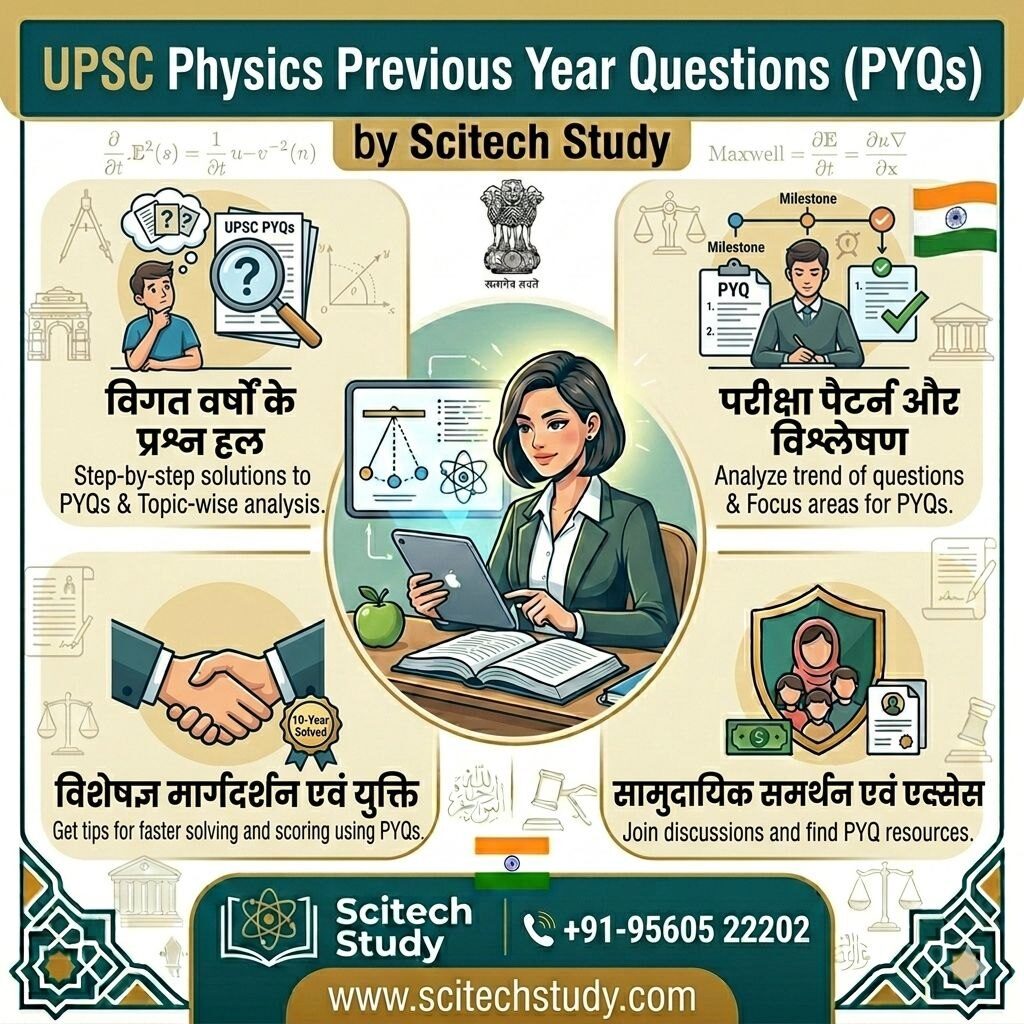
How to Solve Past Papers: A Step-by-Step Blueprint
Simply reading through questions and answers will not build exam-level muscle memory. You need a structured, highly disciplined approach to get the full value out of UPSC Physics Previous Year Questions.
🗓️ Phase 1: Topic-Wise Integration
Do not wait to finish the entire syllabus before opening past papers. As soon as you complete a module—such as Electrostatics—pull out all the relevant UPSC Physics Previous Year Questions from the last 15 years and solve them immediately to lock in the concepts.
⏱️ Phase 2: Timed Simulation
Once 80% of your syllabus is complete, transition to solving full, unbroken 3-hour papers. Sit in a quiet room, strictly monitor your clock, and simulate actual exam conditions to build your mental endurance and time management skills.
📝 Phase 3: Rigorous Self-Correction
Compare your final derivations and steps with standard reference textbooks or expert answer keys. Pay close attention to unit representations, boundary conditions in differential equations, and the clarity of your vector diagrams.
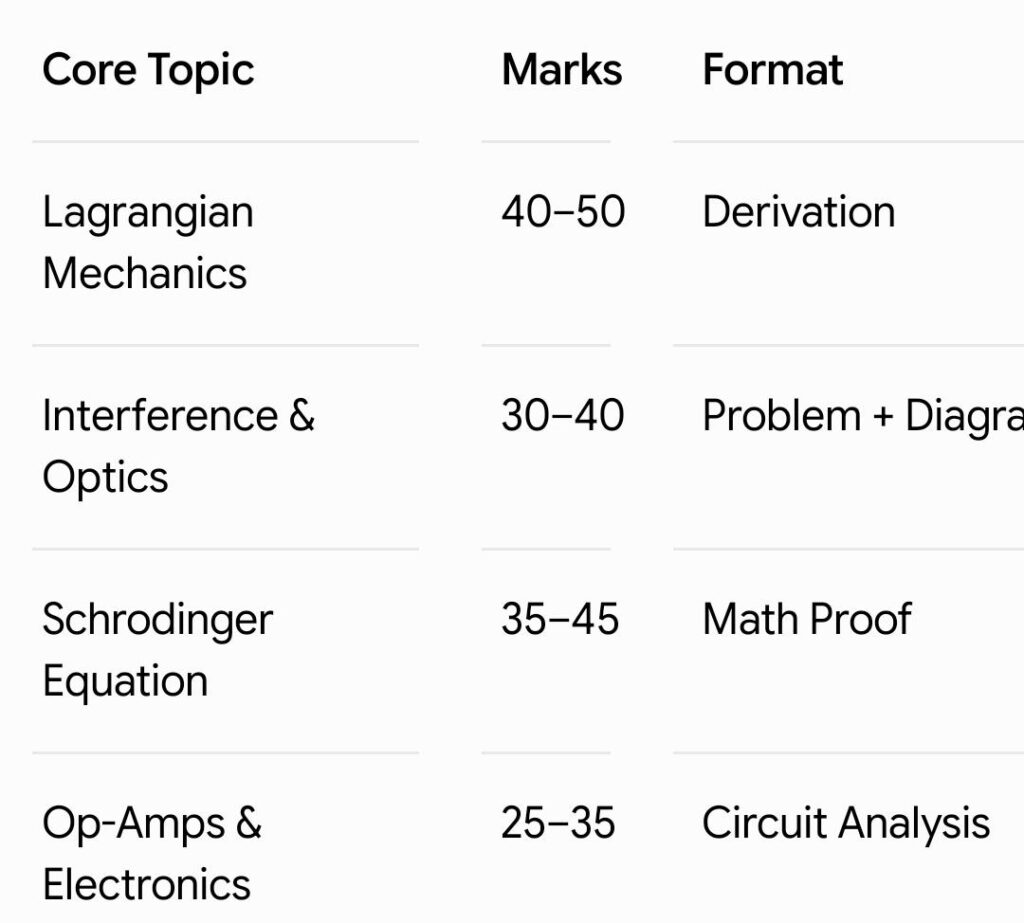
📊 High-Yield Topics Trends in Recent Years
To optimize your revision schedule, it is useful to track which chapters consistently yield high-value questions.
Pro-Tips for Writing High-Scoring Physics Answers
When a UPSC examiner looks at your optional answer sheet, they are looking for clarity, precision, and logical flow. Keep these three core principles in mind:
Draw Clean Diagrams: Whether it is a Michelson interferometer setup or a transistor circuit, use a sharp pencil and label every single component neatly.
State Assumptions Clearly: Before jumping into a complex derivation, write down your starting assumptions (e.g., “Assuming an ideal, incompressible fluid…” or “Under non-relativistic limits…”).
Highlight Final Answers: Draw a clean box around your final mathematical result or numerical value, including the correct SI units.
Accelerate Your Journey with Scitech Study
Navigating the vast landscape of the civil services physics optional requires seasoned mentorship. At Scitech Study, we provide a structured learning ecosystem featuring meticulously solved compilations of UPSC Physics Previous Year Questions, comprehensive test series that mimic the actual exam difficulty, and personalized feedback sessions with industry experts.
Don’t leave your optional score to guesswork. Start practicing systematically, patch up your conceptual gaps, and secure your place on the final merit list. Partner with Scitech Study today and transform your dedication into an extraordinary rank!
Connect With Our Coaching Center
Ready to upgrade your preparation strategy? Contact our academic counselors to join our dedicated UPSC Physics Optional batches or to access our premium study materials:
📱 Phone / WhatsApp: +91-95605 22202
📧 Email: scitechstudyeasy@gmail.com
🌐 Official Website: www.scitechstudy.com
📍 Delhi Head Office: RZ-2054, TKD Extension, Near Tara Apartment, New Delhi – 110019
📍 Chandigarh Center: SCO 35, Sector 16D, Chandigarh – 160015



