
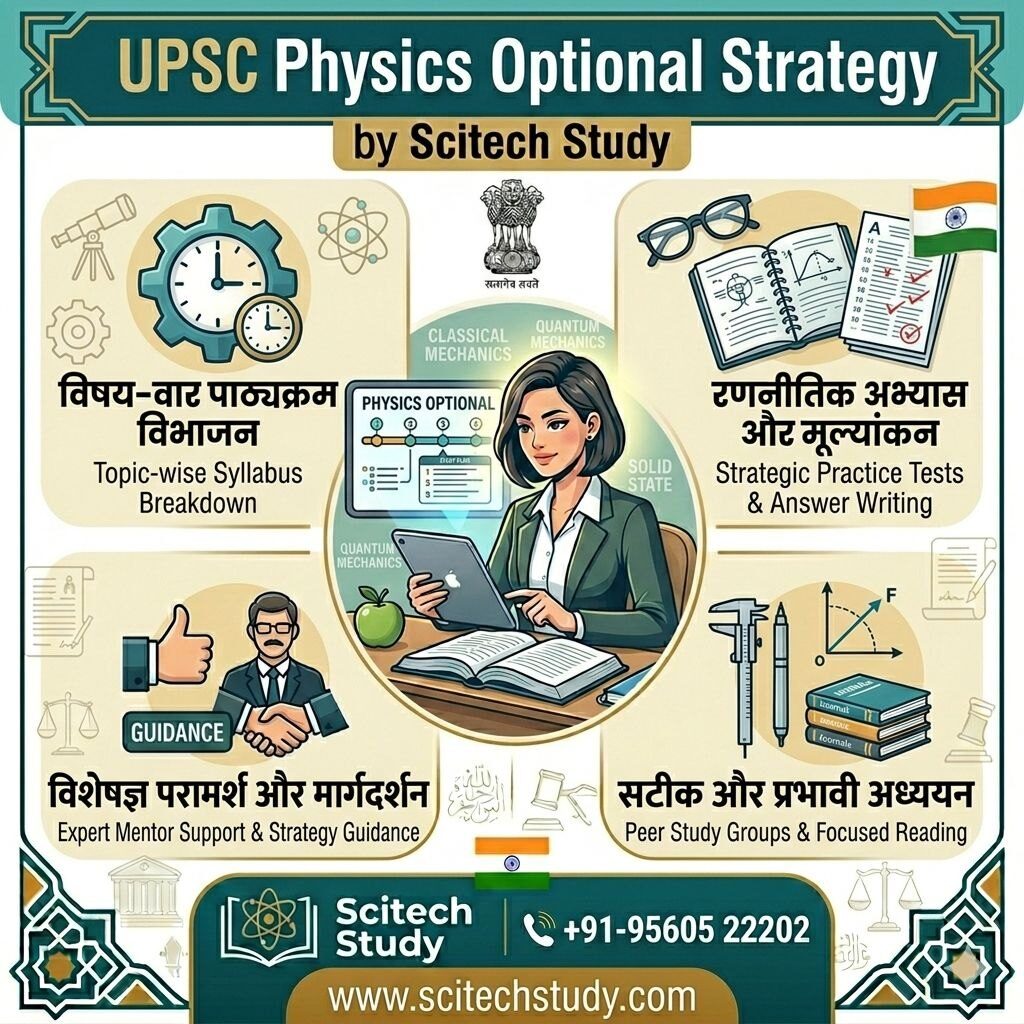
Crack the Civil Services Exam: The Definitive UPSC Physics Optional Strategy
Choosing the right optional subject is arguably the most critical decision in your Civil Services Examination journey. For engineering, mathematics, and science graduates, choosing physics offers a highly rewarding path, primarily due to its objective nature, static syllabus, and direct scoring potential. However, converting this potential into a 300+ score demands more than just casual hard work; it requires a highly structured, well-calibrated UPSC Physics Optional Strategy. By implementing a meticulous UPSC Physics Optional Strategy, you shift your focus away from endless theoretical reading and toward high-yield derivations, precise numerical practice, and disciplined time management. This blueprint acts as your tactical roadmap, keeping your preparation tightly aligned with actual exam patterns and preventing you from getting lost in academic complexities that lie outside the scope of civil services requirements.
At Scitech Study, we have spent years guiding ambitious aspirants through the intricate layers of the Civil Services Exam. We understand that tackling physics under competitive conditions requires a completely different mindset than studying for a university degree. To help you maximize your study hours and build exam-day confidence, our expert faculty has designed an optimized path to success. Here is an in-depth breakdown of how to build a high-scoring preparation routine.
The Hidden Advantages of Choosing Physics Optional
Before diving into the core of your study plan, it helps to understand exactly why physics stands out as an exceptional choice for disciplined candidates.
Absolute Objectivity: Unlike humanities subjects, your marks in physics are not subject to the personal biases or interpretations of the examiner. If your derivation is mathematically sound and your numerical answer is correct, you get full marks.
Static Syllabus: The laws of the universe do not change with current affairs. Once you master the core syllabus, your preparation remains entirely valid year after year without needing constant updates.
Direct Scaling Advantage: Historically, students who demonstrate absolute conceptual clarity and complete their papers cleanly score exceptionally well, often boosting their overall ranks significantly.
🌌 Paper 1: Master the Macro-Physics Fundamentals
Paper 1 covers classical and macro-level physical phenomena. A winning UPSC Physics Optional Strategy divides this paper into two distinct study zones to maximize retention and speed.
🚲 Zone A: Classical Mechanics and Special Relativity
This section forms the backbone of Paper 1. Focus heavily on mastering D’Alembert’s principle, Lagrange’s equations, and Hamiltonian dynamics. For Special Relativity, dedicate substantial time to practicing Lorentz transformations, length contraction, time dilation derivations, and mass-energy equivalence proofs.
🌊 Zone B: Waves, Optics, and Thermodynamics
Optics is highly scoring because the questions are highly visual and structured. Master the mechanics of Michelson’s interferometer, Newton’s rings, and diffraction gratings. In Thermodynamics, your preparation should center entirely around Maxwell’s thermodynamic relations, the laws of thermodynamics, and blackbody radiation formulas.
⚛️ Paper 2: Achieve Precision in Quantum and Modern Physics
Paper 2 shifts into the microscopic domain of quantum mechanics, atomic configurations, and solid-state electronics. This paper is intensely mathematical and demands rigorous attention to symbolic detail.
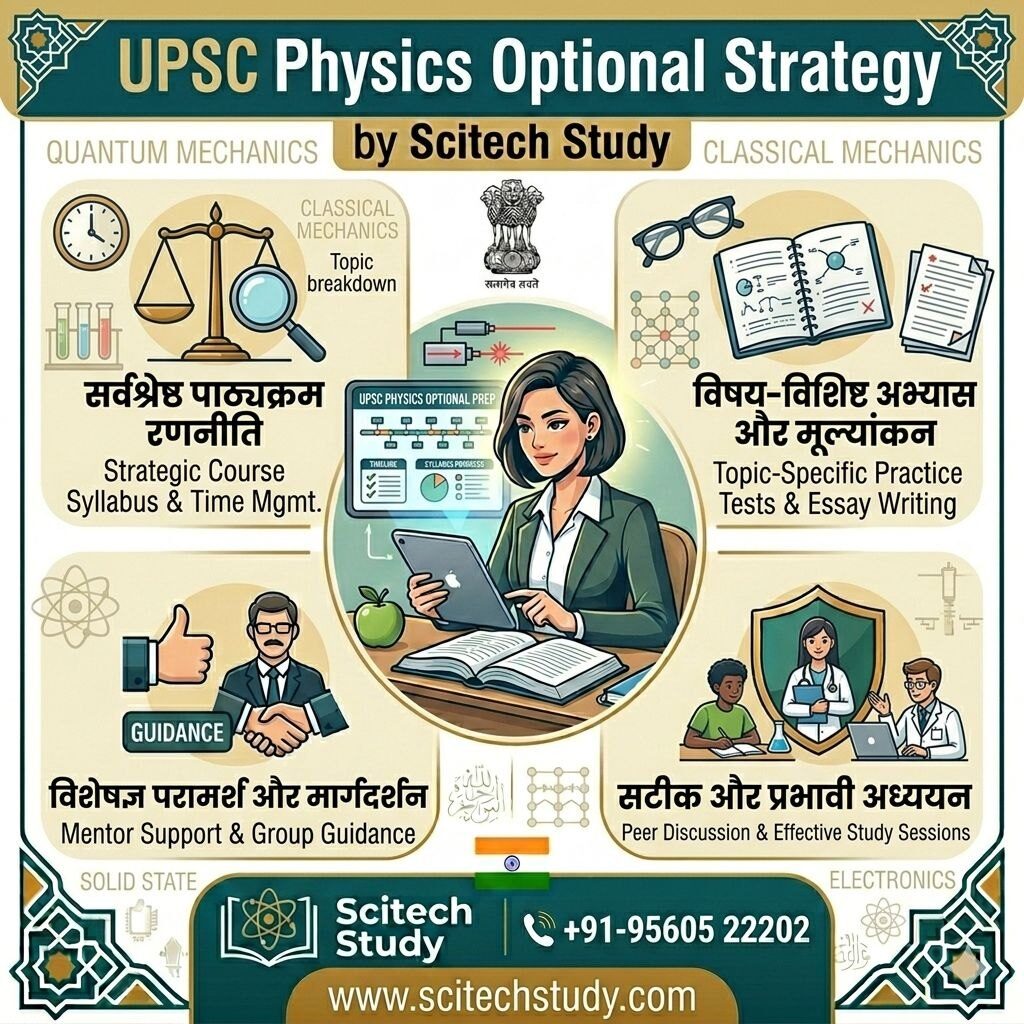
Quantum Mechanics and Atomic Physics
The heart of this section lies in the one-dimensional Schrodinger wave equation. You must confidently know how to apply it to a particle in a box, a linear harmonic oscillator, and a step potential barrier. For atomic physics, focus on the Zeeman effect, Stern-Gerlach experiments, and vector atom models.
⚡ Solid State Physics and Electronics
Many toppers prioritize this segment because it yields direct, compact questions. Ensure you have a flawless understanding of the band theory of solids, intrinsic and extrinsic semiconductors, and operational amplifiers (Op-Amps). Memorize truth tables and circuit diagrams for basic digital logic gates for quick execution.
🛠️ Step-by-Step Blueprint to Execute Your Strategy
To turn your study plan into a functional routine, you must avoid arbitrary learning. A truly robust UPSC Physics Optional Strategy relies on a clear, four-phase execution cycle:
📋 Phase 1: Absolute Syllabus Alignment
Never read beyond what is explicitly written in the UPSC notification. Print the syllabus sheet, paste it on your study desk, and ensure you can check off every keyword methodically. Use standard reference materials like Kleppner & Kolenkow for Mechanics, Ghatak for Optics, and DJ Griffiths for Quantum Mechanics.
✍️ Phase 2: Create a Dedicated Derivation Diary
Physics papers are heavily loaded with standard derivations. Maintain a separate notebook solely for cleanly writing down long derivations from scratch. Practice them until you can recreate the entire logical progression without looking at your notes.
🧮 Phase 3: High-Frequency Numerical Practice
A common trap for many students is spending too much time reading theory and too little time solving problems. Dedicate at least 40% of your daily study block to solving past year questions and textbook end-chapter problems. Focus heavily on keeping your calculation steps clean and error-free.
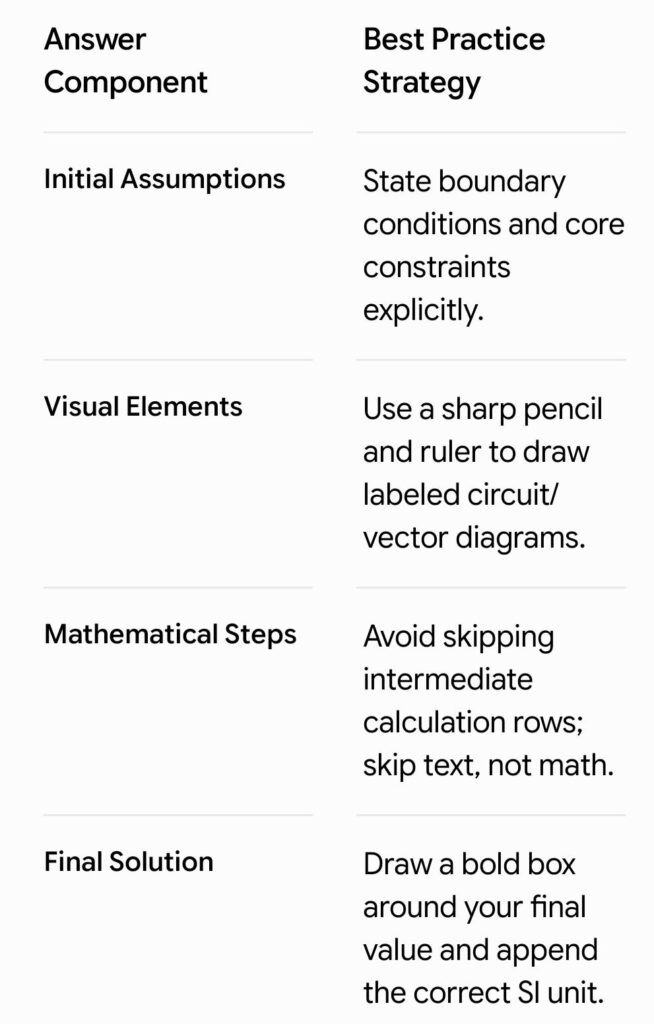
📊 High-Yield Blueprint for Answer Structuring
When an examiner opens your optional answer book, your layout should communicate professionalism, structural clarity, and scientific precision.
Crucial Dos and Don'ts to Safeguard Your Score
To ensure your UPSC Physics Optional Strategy delivers optimal results on exam day, integrate these tactical habits into your daily revision cycle:
DO Practice Vector Notation Correctly: Careless omissions of vector arrows over force, velocity, or electric field symbols can lead to unnecessary mark deductions.
DO Track Your Timing: Paper completion is a massive challenge in physics. Ensure you know exactly how many minutes you can afford to spend on a 10-mark question versus a 20-mark question.
DON’T Guess Calculator Keys: Get completely familiar with your official non-programmable scientific calculator during daily practice. Do not wait until the exam hall to figure out complex button configurations.
Maximize Your Performance with Scitech Study
Achieving excellence in a highly technical optional subject requires more than solitary effort—it demands seasoned guidance and rigorous peer evaluation. At Scitech Study, we provide a holistic learning environment specifically designed for civil services aspirants. From comprehensively solved past year question banks and highly targeted study notes to a competitive test series evaluated by domain experts, we give you all the tools required to convert your potential into a top-tier rank.
Don’t let the vastness of the syllabus overwhelm your ambition. Streamline your hard work, sharpen your problem-solving speed, and approach the exam with unmatched confidence. Connect with Scitech Study today and take a definitive, well-guided step toward achieving your IAS dreams!
Get in Touch with Our Academic Team
Ready to supercharge your civil services preparation? Contact our administrative desk today to inquire about our upcoming Physics Optional foundational batches, specialized test series, or premium study resources:
📱 Phone / WhatsApp: +91-95605 22202
📧 Official Email: scitechstudyeasy@gmail.com
🌐 Web Portal: www.scitechstudy.com
📍 Delhi Center Address: RZ-2054, TKD Extension, Near Tara Apartment, New Delhi – 110019
📍 Chandigarh Center Address: SCO 35, Sector 16D, Chandigarh – 160015



