
Ace the Civil Services: The Ultimate Guide to the UPSC Physics Optional Test Series
Choosing Physics as your optional subject for the UPSC Civil Services Examination is a highly strategic decision. Known for its exact, scoring nature, a strong performance here can single-handedly skyrocket your final merit ranking. However, transitioning your academic knowledge into a high-scoring answer sheet under severe exam-hall time constraints requires a completely different level of preparation. The absolute defining factor that separates a hopeful aspirant from a successful civil servant is rigorous, timed writing practice via a dedicated UPSC Physics Optional Test Series. Engaging with a comprehensive UPSC Physics Optional Test Series doesn’t just evaluate your conceptual depth; it fundamentally retrains your brain to structure lengthy derivations neatly, select the highest-scoring question combinations in Section A and B, and eliminate costly calculation errors before your actual mains attempt.
At Scitech Study, we understand that mastering physics for civil services requires deep precision, structured logical progression, and flawless execution. Our specially designed evaluation program mirrors the exact standards, evaluation metrics, and structural complexity used by UPSC examiners. This deep-dive guide breaks down how a simulated testing program can optimize your revision, streamline your layout style, and help you unlock maximum marks.
Why a Dedicated Test Series Changes the Game
Unlike humanities optionals where answers can be subjective, physics rewards absolute structural correctness. Reviewing past toppers’ trajectories reveals that enrolling in a professional testing platform offers three massive execution advantages:
Optimizing Question Selection: UPSC papers give you significant choice flexibility across Section A and B. Regular test practice trains your eye to quickly spot and choose the exact numerical-heavy matrices that maximize your scoring potential.
Mastering the Space Constraints: The Question-Cum-Answer Booklet (QCAB) provides a fixed, rigid space for every answer. Writing full-length tests ensures you learn how to condense massive derivations into the exact number of pages allowed.
Fixing “Silly” Mathematical Slips: Under high exam stress, simple calculation mistakes, incorrect sign conversions, or missing integration constants can destroy a 20-mark question. A test series catches these behavioral errors early so you don’t repeat them.
Complete Sectional Mapping of the Test Program
A truly exhaustive UPSC Physics Optional Test Series cannot rely on generic questions. It must systematically test your speed and accuracy across the entire micro-syllabus of Paper 1 and Paper 2.
📐 Paper 1: Classical and Macro-Level Physics
This paper tests foundational concepts and demands flawless mathematical proofs combined with crisp, labeled illustrations. Your sectional tests must intensely cover:
Mechanics: D’Alembert’s principle, Lagrangian and Hamiltonian equations, central force motion, and rigid body dynamics.
Special Relativity: Lorentz transformations, length contraction, time dilation, and mass-energy equivalence.
Waves and Optics: Interferences in thin films, Michelson’s interferometer, Fraunhofer diffraction, and laser physics.
Electricity and Magnetism: Gauss’s law, Biot-Savart law, Maxwell’s equations in vacuum and media, and electromagnetic wave propagation.
Thermodynamics & Statistical Physics: Laws of thermodynamics, Maxwell’s relations, blackbody radiation, and classical/quantum statistics.
🔬 Paper 2: Modern and Quantum Applied Physics
This paper transitions into the microscopic, highly abstract domain where precise mathematical operators and absolute clarity in writing steps are heavily rewarded. Our modules provide extensive coverage of:
Quantum Mechanics: Wave-particle duality, Schrodinger’s wave equation, linear operators, particle in a box, and tunneling effects.
Atomic and Molecular Physics: Bohr’s theory, vector model of the atom, Zeeman effect, Franck-Condon principle, and Raman spectroscopy.
Nuclear and Particle Physics: Ground state properties of nuclei, liquid drop and shell models, alpha/beta/gamma decay, and elementary particles.
Solid State Physics & Electronics: Bravais lattices, band theory of solids, intrinsic/extrinsic semiconductors, operational amplifiers (Op-Amps), and digital logic gates.
⚙️ The Strategic 4-Step Answer Execution Blueprint
Simply looking over an answer key after writing a paper will not build true structural writing muscle. To squeeze the maximum benefit out of your UPSC Physics Optional Test Series, use this disciplined structural execution framework:
The Four-Phase Study Blueprint:
Explicit Assumption Listing: Before jumping into any complex derivation, always explicitly list your starting boundary conditions and physical approximations (e.g., “Assuming an ideal, non-viscous fluid…”).
Neat Diagram Integration: Always use a sharp pencil to integrate clean, well-labeled circuit or vector diagrams right alongside your mathematical text. A good visual cuts down your writing time.
Step-by-Step Derivation Flow: Avoid skipping intermediate mathematical steps. Show your integrations, vector cross-products, and substitutions clearly to secure partial marking even if your final arithmetic has an error.
Clean Box Highlighting: Once you reach the final numerical value or structural formula, draw a clean, prominent box around it and state the exact SI units explicitly.
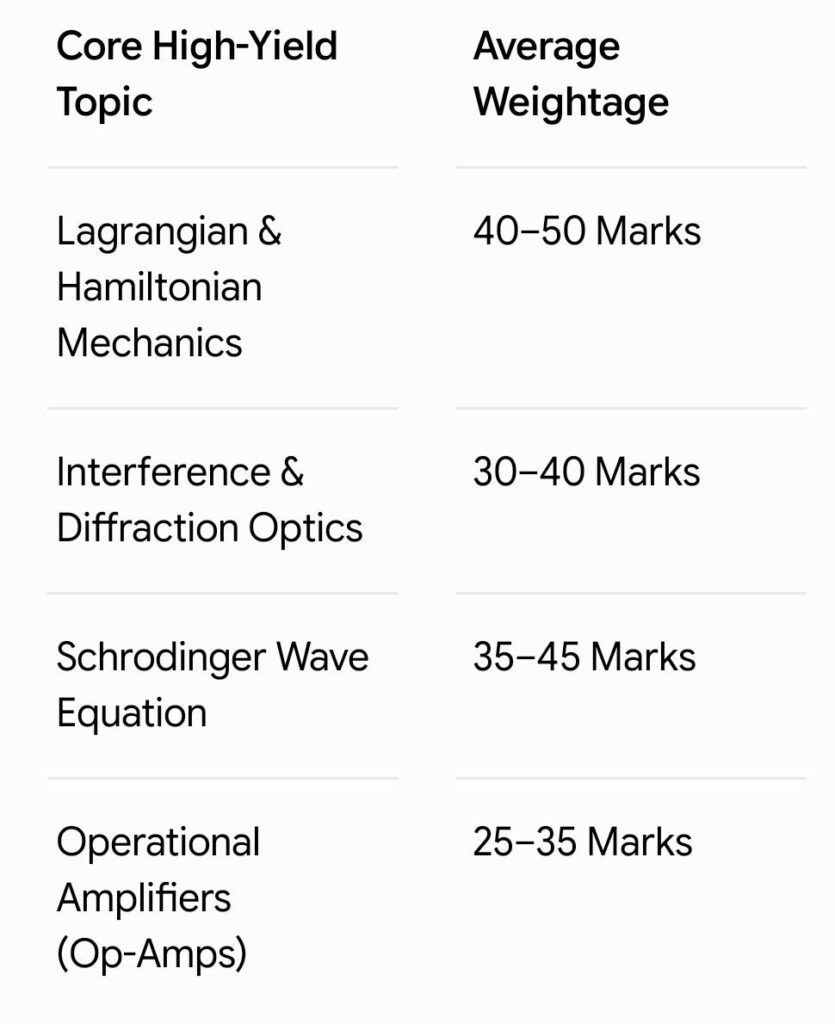
High-Yield Trends and Weightage Architecture
To help you balance your study and revision hours effectively, our academic council has analyzed historical testing trends to identify the core chapters that yield maximum marks:
Critical Self-Correction Strategies for Mains 2026
When you sit down to review your evaluated test scripts, direct your attention to these three core behavioral metrics:
The Time-to-Mark Ratio: Ensure you aren’t spending 25 minutes on a 10-mark question. If a derivation is getting stuck, park it, move to the next question, and return to it later.
Dimensional Integrity Check: Always cross-verify if the dimensions of your derived final expression match the physical quantity asked in the question prompt. This instantly flags hidden algebra errors.
Adherence to QCAB Margin Rules: Keep all your mathematical scratch work neatly restricted to the designated rough space. Writing calculations inside the margins can attract negative marking penalties.
Maximize Your Rank with Scitech Study
Navigating the intensely competitive waters of the civil services mains requires a blend of raw intelligence and seasoned institutional guidance. At Scitech Study, we provide a complete, robust training platform featuring a highly relevant UPSC Physics Optional Test Series, one-on-one personal evaluation feedback from veteran physics professors, and a rich database of standard model answers designed for rapid revision.
Stop leaving your mains score to chance or unguided self-evaluation routines. Join our specialized testing batches, wipe out your structural writing weak spots under expert mentorship, and turn your technical dedication into a top-ranking Civil Services merit position. Contact our admissions desk today to secure your seat!
Connect with Our Central Academic Center
Ready to upgrade your optional answer-writing strategy? Reach out to our academic advisors today to check test batch timetables, request model answer keys, or schedule a personal strategy consultation:
📱 Helpline / WhatsApp: +91-95605 22202
📧 Admissions Email: scitechstudyeasy@gmail.com
🌐 Official Web Portal: www.scitechstudy.com
📍 Delhi Corporate Headquarters: RZ-2054, TKD Extension, Near Tara Apartment, New Delhi – 110019
📍 Chandigarh Branch Campus: SCO 35, Sector 16D, Chandigarh – 160015



