
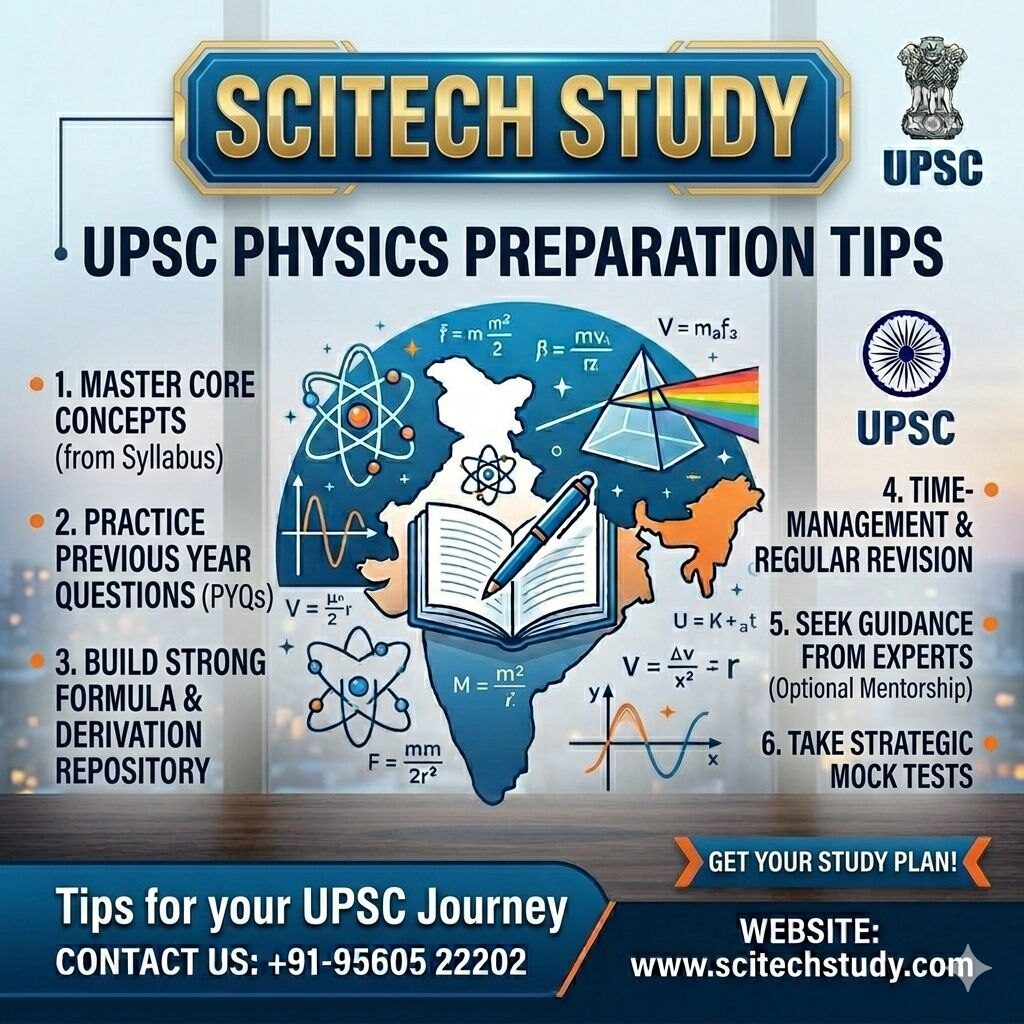
Unlock the Civil Services Rank: Proven UPSC Physics Preparation Tips
Choosing Physics as your optional subject for the UPSC Civil Services Examination is a highly strategic and rewarding decision. Because physics is an exact science with a completely static syllabus, it offers a level of scoring predictability that humanities subjects simply cannot match. However, translating this potential into a 300+ score demands a precise, disciplined approach that transitions from mere academic understanding to highly targeted competitive execution. Implementing expert UPSC Physics Preparation Tips right from the start of your journey allows you to navigate the vast syllabus efficiently, optimize your study tracking, and master the art of writing answers that instantly impress a technical examiner. By anchoring your daily routine around specialized UPSC Physics Preparation Tips, you can balance General Studies with your optional, avoid common derivation traps, and build the analytical speed necessary to conquer both Paper 1 and Paper 2 under tight examination hall constraints.
At Scitech Study, we have spent years guiding ambitious civil services aspirants to top ranks. We understand that scoring high in UPSC Physics requires a completely different mindset than clearing an engineering or master’s degree. To help you transform your hard work into an extraordinary score, our expert optional faculty has compiled a definitive operational blueprint. Read on to discover the essential strategies that will give your optional preparation a massive competitive boost.
The Core Advantages of Physics Optional
Before diving into execution tactics, it is crucial to understand the unique strengths of this subject, which can provide immense motivation throughout your preparation cycle:
Absolute Scoring Objectivity: In physics, an answer is either right or wrong. If your derivation steps are correct and your final numerical value matches the key, the examiner cannot deduct marks based on subjective bias.
100% Static Syllabus: Unlike general studies, there are zero dynamic current affairs updates to track. A concept you master today remains identically valid and testable on exam day.
Direct Overlap with Scientific Concepts: The analytical skills and problem-solving habits you build while tackling physics naturally enhance your data interpretation and logical reasoning abilities for the CSAT paper.
Deconstructing Paper 1: Macro-Level Mastery
Paper 1 deals primarily with classical and macro-level physical phenomena. To maximize your scoring efficiency in this paper, prioritize these foundational modules:
📐 Mechanics and Special Relativity
This section carries major weightage and demands absolute clarity on coordinate systems. Focus heavily on D’Alembert’s principle, Lagrange’s and Hamiltonian equations, and central force motion. For Special Relativity, ensure you can flawlessly derive Lorentz transformations and mass-energy equivalence steps on a blank sheet of paper.
🌊 Waves, Optics, and Thermodynamics
Optics questions appear with incredible regularity. You must gain total control over interference setups (like Michelson’s interferometer) and diffraction gratings. In Thermodynamics, master Maxwell’s relations, the laws of thermodynamics, and the mathematical derivations behind blackbody radiation.
🔬 Deconstructing Paper 2: Quantum and Micro-Level Precision
Paper 2 shifts into modern, quantum, and micro-level applications. This paper is highly mathematical and rewards absolute conceptual precision.
⚛️ Quantum Mechanics and Atomic Physics
Past papers show that the one-dimensional Schrodinger wave equation and its various boundary applications (such as a particle in a box) are asked almost every alternate year. In atomic physics, allocate significant time to mastering the Zeeman effect, Stern-Gerlach experiments, and foundational nuclear shell models.
⚡ Solid State Physics and Electronics
This is widely considered the fastest-scoring area of Paper 2. Ensure you have clean, scannable notes on the band theory of solids, intrinsic versus extrinsic semiconductor physics, and operational amplifiers (Op-Amps) alongside basic digital logic gates.
A Disciplined 4-Phase Study Blueprint
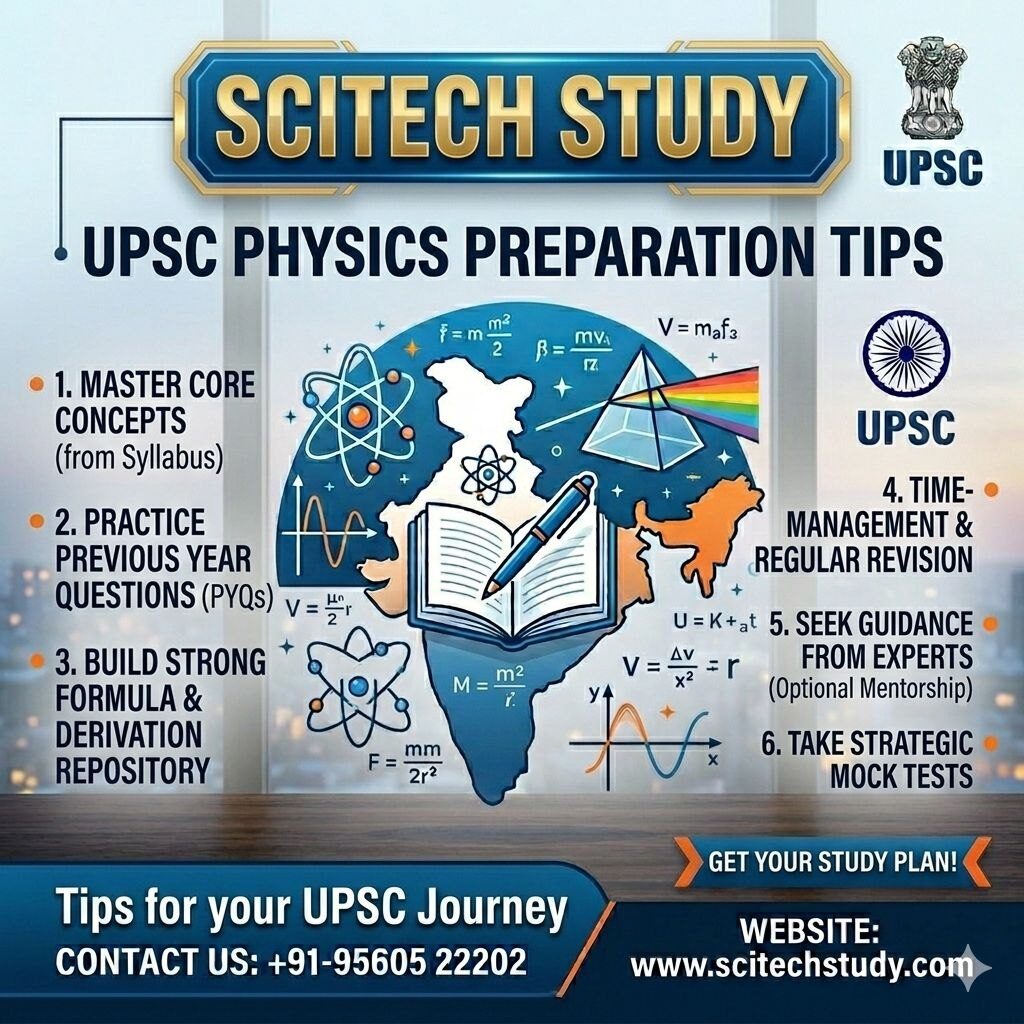
Simply reading through textbooks passively will not build the technical muscle memory required to write flawless answers under time pressure. Our core UPSC Physics Preparation Tips center around a highly structured, active learning methodology:
The Four-Phase Study Blueprint:
Syllabus-Aligned Reading: Read standard reference books (such as Kleppner for Mechanics or Ghatak for Optics) strictly keeping the official UPSC syllabus open beside you to avoid studying irrelevant topics.
Active Derivation Practice: Maintain a dedicated “Derivation Registry.” Write out every major equation proof from scratch without looking at the textbook to ensure your steps are logical and clean.
Past Question Integration: The moment you finish a chapter, instantly pull out the past 15 years of UPSC papers and solve those questions to verify if your understanding matches exam-level difficulty.
Timed Answer-Writing Drills: As Mains approaches, transition into writing full, unbroken 3-hour tests to build the physical endurance and mental pacing needed to complete the paper comfortably.
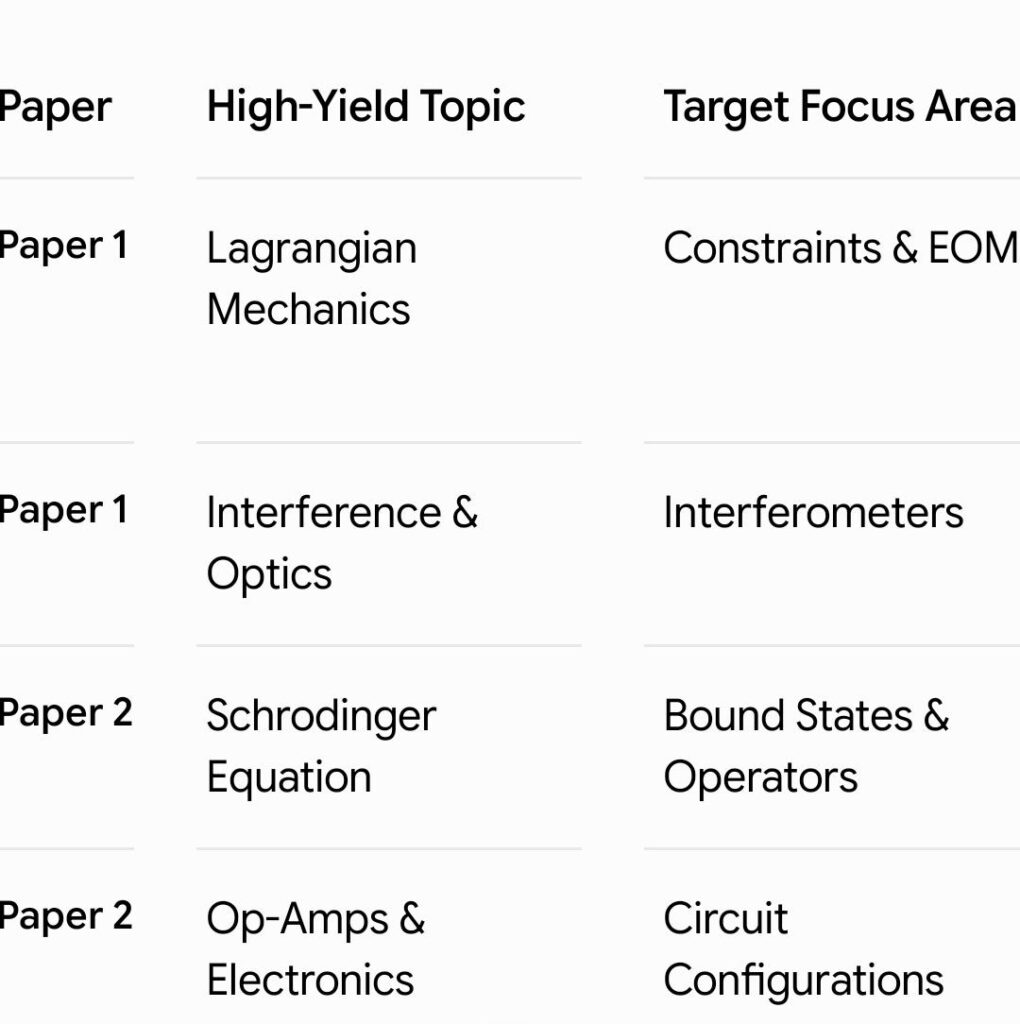
High-Yield Topic Prioritization
To help you manage your limited study hours efficiently, our academic board has analyzed recent testing trends to highlight the high-value chapters that yield maximum returns:
Practical Presentation Secrets for Maximum Marks
When a UPSC examiner opens your answer script, your presentation layout heavily influences their marking. Implement these simple presentation strategies to instantly upgrade your score:
Draw Labeled Diagrams Explicitly: Whether it is a wave propagation model or a complex transistor circuit, use a sharp pencil and draw a clean, neatly labeled diagram to accompany your text explanation.
State Assumptions Clearly at the Start: Before launching into any complex derivation, write down your starting boundary conditions or physical approximations (e.g., “Assuming an ideal, non-viscous fluid…” or “Under non-relativistic limits…”).
Draw a Box Around Final Values: Once you arrive at your final mathematical result or numerical solution, enclose it cleanly inside a box and write the exact SI units alongside it to highlight your final answer.
Accelerate Your Journey with Scitech Study
Navigating the deep mathematical waters of the UPSC Physics Optional requires seasoned mentorship, structural guidance, and a highly disciplined environment. At Scitech Study, we provide an intensive preparation platform featuring fully worked-out solutions for decades of past civil services papers, a specialized test series that perfectly mirrors actual evaluation standards, and direct one-on-one strategy sessions with veteran optional experts.
Stop relying on unguided study routines or disorganized notes. Join our upcoming specialized optional batches, implement our proven UPSC Physics Preparation Tips, fix your conceptual weak spots under expert guidance, and turn your academic dedication into a top-ranking civil services score. Contact our admissions desk today to reserve your seat!
Connect with Our Local Academic Centers
Ready to take your optional preparation to the absolute highest level? Reach out to our academic advisors today to check live batch timings, explore flexible fee structures, or attend a free introductory strategy demo:
📱 Direct Helpline / WhatsApp: +91-95605 22202
📧 Admissions Team Email: scitechstudyeasy@gmail.com
🌐 Official Web Portal: www.scitechstudy.com
📍 Delhi Corporate Headquarters: RZ-2054, TKD Extension, Near Tara Apartment, New Delhi – 110019
📍 Chandigarh Branch Office: SCO 35, Sector 16D, Chandigarh – 160015



