
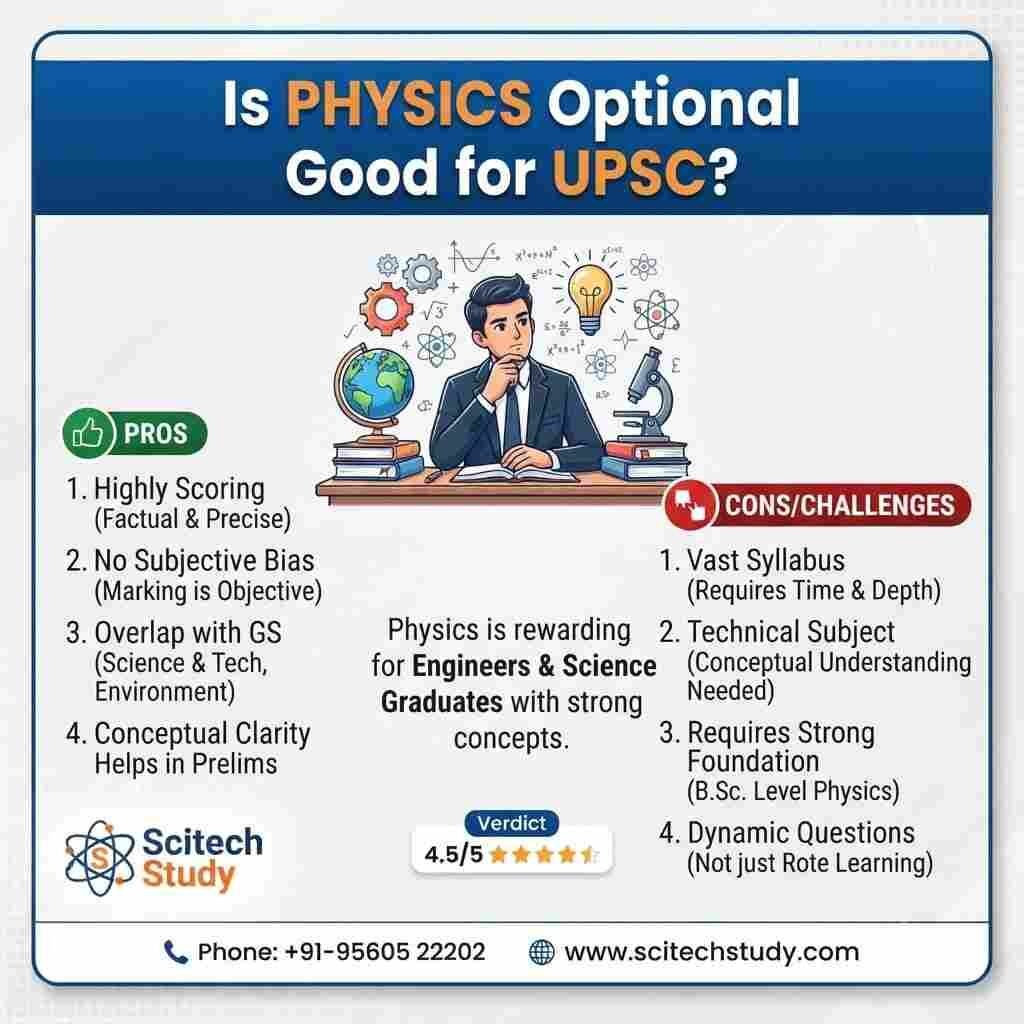
Making the Strategic Choice: Is Physics Optional Good for UPSC? A Comprehensive Analysis by Scitech Study
Choosing the right optional subject for the Civil Services Examination is one of the most critical decisions an aspirant will make, as it directly impacts 500 vital marks in the Mains merit list. For candidates coming from an engineering, technology, or pure science background, the persistent question arises: Is Physics Optional Good for UPSC? When evaluating the question Is Physics Optional Good for UPSC?, one must weigh its distinct advantages—such as completely objective scoring, immunity to subjective evaluation, and predictable question formats—against its vast, mathematically rigorous syllabus. At Scitech Study, our faculty guides aspirants through every stage of this decision-making process, helping them recognize how a structured approach transforms scientific knowledge into high ranks.
The Unmatched Power of Objective Scoring
One of the biggest strengths of technical optionals is their absolute grading criteria. In humanities subjects, scores often vary based on the perspective, political outlook, or writing style of the examiner. A well-written sociology or history essay might receive wildly differing marks depending on who evaluates the paper.
In physical sciences, this subjectivity disappears. A derivation is either mathematically correct or incorrect; a numerical problem either reaches the accurate value with appropriate units or it does not. If you present your proofs clearly, follow logical steps, and box accurate final results, evaluators award full marks. This objective reliability makes physics one of the few optional subjects capable of consistently producing scores above 300 marks.
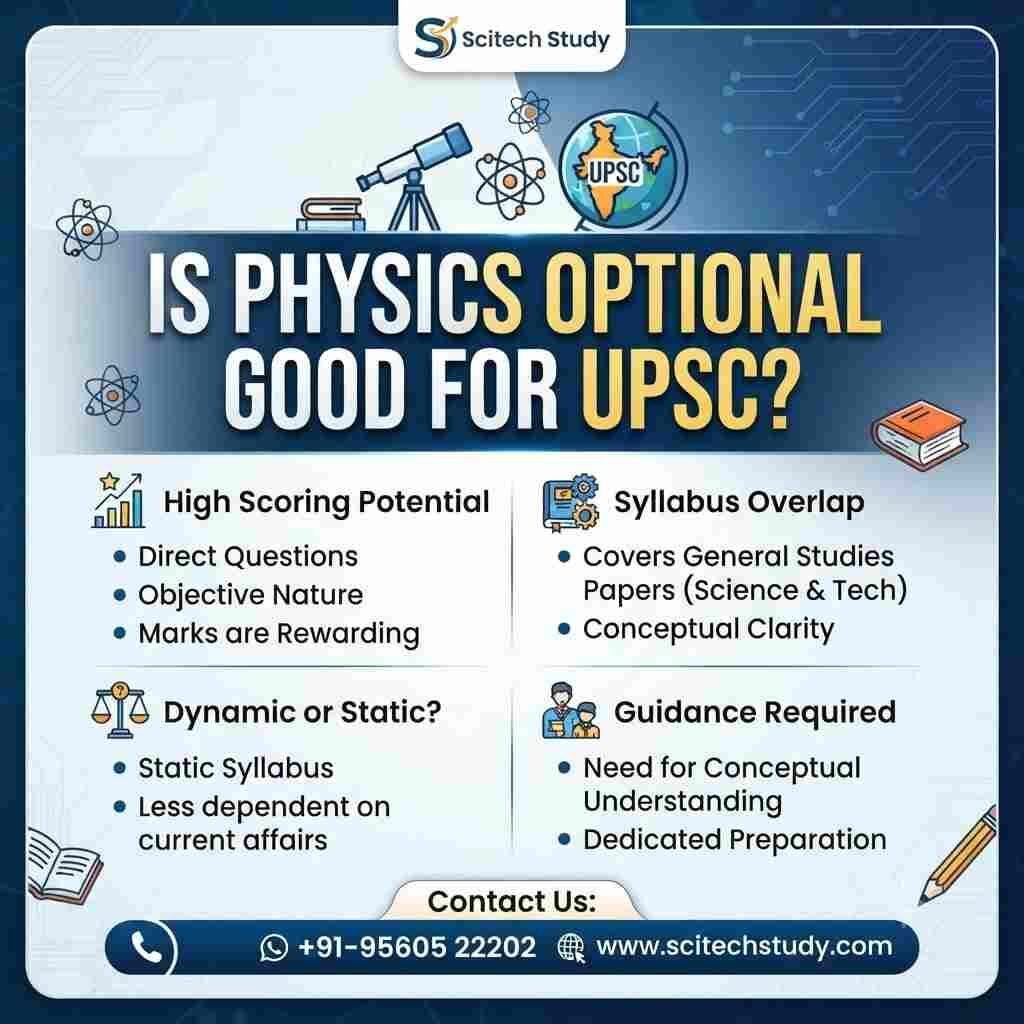
Who Should Opt for Physics as Their Optional Subject?
While the potential for high scores is immense, physics is not a subject that can be chosen purely on a whim. The most important prerequisite when asking Is Physics Optional Good for UPSC? is having genuine comfort with higher-level mathematics and core undergraduate physics concepts.
Aspirants who hold degrees in Mechanical Engineering, Electrical Engineering, Electronics, or Bachelor of Science/Master of Science in Physics find a significant overlap between their college coursework and the UPSC syllabus. Candidates who enjoy working through differential equations, vector calculus, and mechanics problems thrive in this discipline, turning their existing academic training into a competitive advantage.
Paper I vs. Paper II: Navigating the Syllabus Structure
The UPSC Physics optional syllabus is neatly divided into two distinct papers that test classical foundations alongside modern quantum and microscopic frameworks:
Paper I (Classical Foundations): Covers Mechanics (Lagrangian and Hamiltonian formulations), Waves and Geometrical/Physical Optics, Electricity and Magnetism (Maxwell’s equations and electrodynamics), and Thermodynamics/Statistical Physics.
Paper II (Modern & Quantum Physics): Focuses on Quantum Mechanics, Atomic and Molecular Physics, Nuclear and Particle Physics, and Solid State Physics and Devices.
Mathematical Demands: Both papers require fluency in vector analysis, Fourier and Laplace transformations, complex analysis, and boundary-value problems.
Balance of Proofs & Numericals: A typical paper features roughly 50% theoretical derivations and 50% applied numerical problems.
Overcoming the Common Challenges of the Subject
Aspirants frequently wonder: Is Physics Optional Good for UPSC? when considering the sheer volume of the syllabus and the lack of broad overlap with General Studies papers. While it is true that physics does not directly help with GS Paper II or GS Paper III beyond general science awareness, this perceived drawback is offset by syllabus stability.
Unlike humanities optionals that require constant updating with dynamic current affairs, dynamic government schemes, and shifting geopolitical theories, the physics syllabus remains strictly static. Newton’s laws, Maxwell’s equations, and Schrödinger’s wave equation do not change year over year. Once you master the fundamentals and derivations, your notes remain permanently valid.
A Blueprint for Scoring High in Mains Answer Writing
Success in the Mains examination depends heavily on answer presentation and mathematical clarity. Aspirants preparing for physics must cultivate a clean, disciplined writing layout:
Step 1: State Explicit Assumptions: Begin every derivation by listing the physical constraints, coordinate systems, and system boundaries clearly.
Step 2: Neat Vector and Ray Diagrams: Accompany your calculations with hand-drawn, neatly labeled schematic diagrams to illustrate the physical phenomenon.
Step 3: Logical Derivation Flow: Avoid skipping essential algebraic transitions; show intermediate steps so the evaluator can track your mathematical logic.
Step 4: Dimension and Unit Verification: Double-check that your final calculated quantities match standard SI units and highlight your final answers in clean boxes.
Streamlined Study Materials and Workbooks at Scitech Study
Navigating multiple foreign-author reference books for eight sub-disciplines can quickly lead to preparation burnout. Scitech Study simplifies this journey by providing concise, exam-focused study modules that distill standard reference texts into readable, high-yield booklets.
Every theoretical unit is supported by a dedicated Previous Year Question (PYQ) workbook covering over two decades of solved UPSC questions. This targeted material ensures that aspirants can test their conceptual understanding against actual examination trends, eliminating unnecessary guesswork.
Hybrid Learning Flexibility for Serious Aspirants
Balancing optional preparation with General Studies, essay writing, and daily answer practice demands efficient time management. Aspirants assessing Is Physics Optional Good for UPSC? benefit greatly from flexible learning formats.
Scitech Study operates a hybrid model, allowing candidates to attend interactive offline lectures at our Chandigarh center or access high-definition live streams and recorded sessions online. Our faculty provides continuous academic doubt clearance, personalized answer copy evaluations, and regular test series to keep your preparation on track.
Proven Track Record of Success
Over the years, Scitech Study has built a solid reputation for helping engineering and science graduates secure top marks in competitive examinations. When candidates ask our mentors Is Physics Optional Good for UPSC?, we demonstrate how combining core conceptual mastery with rigorous numerical practice consistently yields top percentiles.
Our structured guidance, topic-wise assessments, and personalized feedback enable aspirants to face both Paper I and Paper II with complete composure and confidence.
Frequently Asked Questions (FAQs)
Q1: Is Physics Optional Good for UPSC candidates without a science background?
No, physics requires an extensive background in undergraduate-level mathematics and physical sciences. Candidates without a science or engineering degree may find the advanced calculus and quantum mechanics extremely challenging to master from scratch.
Q2: When asking “Is Physics Optional Good for UPSC?”, how many hours of daily study are required?
Aspirants should allocate around 3 to 4 hours daily specifically for their physics optional, dividing their time between learning theoretical derivations and solving numerical problems.
Q3: Does the physics syllabus overlap with the General Studies papers?
Direct overlap with General Studies is limited primarily to the Science & Technology section of GS Paper III. However, the static nature of physics frees up time that would otherwise be spent updating current affairs for dynamic humanities optionals.
Q4: How important is Previous Year Question (PYQ) practice for physics optional?
PYQ practice is essential. Over 60% of question patterns, derivation frameworks, and numerical concepts are repeated or adapted from the past 15 to 20 years of UPSC papers.
Contact Scitech Study and Start Your Preparation Today
Admissions for our dedicated UPSC Physics Optional foundation batches and answer-writing programs are now open. Batch sizes are strictly limited to ensure individualized attention and detailed copy evaluation for every aspirant.
Reach out to our academic counseling desk for course details, syllabus breakdowns, and free demo access:
📍 Campus Address: Scitech Study, SCO 35, Sector 16D, Chandigarh – 160015
📞 Official Contact Line: +91-95605 22202
📧 Academic Email: scitechstudyeasy@gmail.com
🌐 Official Web Portal: www.scitechstudy.com
Stop wondering Is Physics Optional Good for UPSC? and start building the structured study habits that lead to top ranks. Partner with Scitech Study and turn your technical background into your greatest scoring asset!



