
Decode the Mains Exam: Complete UPSC Physics Optional Syllabus Explained by Scitech Study
Choosing Physics as your optional subject for the Civil Services Examination is one of the most scoring decisions an aspirant can make, provided they navigate the curriculum with precision and strategic depth. To build a winning preparation roadmap, having the full UPSC Physics Optional Syllabus Explained in a clear, actionable format is essential for targeting high scores in both Paper I and Paper II. At Scitech Study, our experienced faculty believes that when you have the complete UPSC Physics Optional Syllabus Explained down to its micro-topics, you eliminate guesswork, avoid irrelevant study materials, and focus directly on high-yield derivations and numericals. Grounding your study plan in an authoritative subject breakdown alongside professional classroom mentorship transforms this demanding technical syllabus into your biggest competitive advantage in the UPSC Mains.
The Strategic Advantage of Deconstructing the Official Syllabus
Physics stands out among optional subjects because of its absolute objectivity and high scoring potential. Unlike humanities optionals where marks often fluctuate based on subjective evaluation, physics rewards clarity, accurate mathematics, and neat derivations with top percentiles. However, the sheer breadth of the curriculum often overwhelms candidates who attempt to read standard textbooks without clear topic boundaries.
Getting the UPSC Physics Optional Syllabus Explained structurally helps you differentiate between fundamental college-level theory and the specific, high-speed problem-solving skills required by UPSC evaluators. Breaking down the syllabus into distinct, manageable units allows you to plan your revision cycles effectively, master standard previous year question (PYQ) trends, and allocate your daily study hours with complete confidence.
Expert Mentorship Under Premier Science Faculty
At Scitech Study, our classroom guidance is led by seasoned educators with over 15 years of specialized experience in coaching science aspirants for competitive examinations. Our mentors bridge the gap between academic textbook reading and the structured presentation style demanded in the UPSC Mains exam hall.
Under personalized faculty supervision, aspirants learn how to decode complex proofs, identify recurring examination themes, and apply time-saving mathematical shortcuts. Rather than struggling alone with abstract formulations, students receive direct mentorship that clarifies every nuance of the syllabus, builds analytical speed, and instills the discipline required to clear national-level competitive benchmarks.
Paper I Breakdown: Classical Mechanics to Thermal Physics
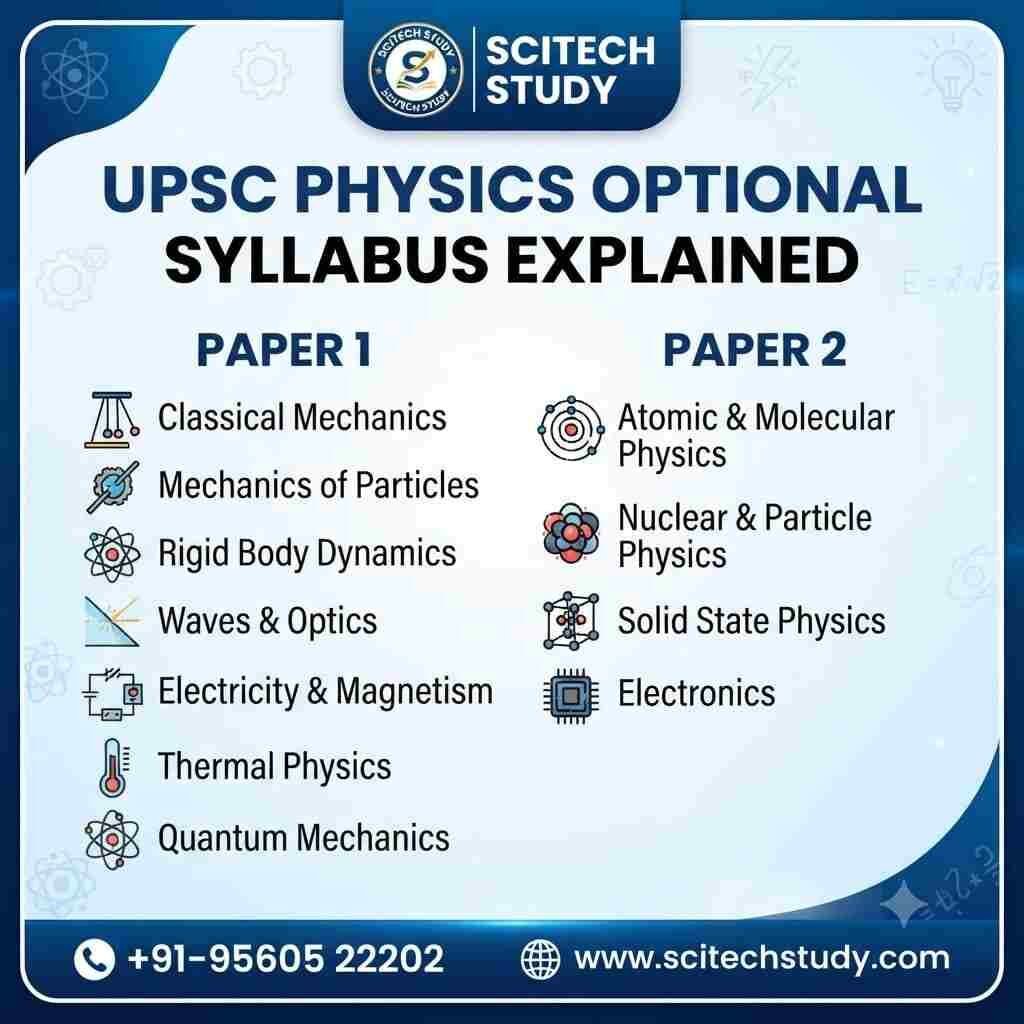
Paper I forms the classical backbone of the optional examination. Having the Paper I section of the UPSC Physics Optional Syllabus Explained step-by-step ensures you cover all core topics systematically:
Mechanics of Particles & Rigid Bodies: In-depth focus on conservation laws, central force motion, Kepler’s laws, Rutherford scattering, mechanics of continuous media, and advanced Lagrangian and Hamiltonian formalisms.
Special Relativity, Waves & Oscillations: Covering Lorentz transformations, length contraction, time dilation, mass-energy equivalence, damped and forced harmonic oscillations, resonance, and phase velocity versus group velocity.
Geometrical & Physical Optics: Comprehensive study of Fermat’s principle, matrix methods in paraxial optics, interference (thin films and Newton’s rings), Fraunhofer and Fresnel diffraction, resolving power, and polarization mechanisms.
Electricity & Magnetism: Detailed analysis of Gauss’s law, Laplace and Poisson equations, dielectrics, Biot-Savart law, Ampere’s circuital law, Faraday’s law of induction, and Maxwell’s electromagnetic field equations in vacuum and medium.
Thermodynamics & Statistical Physics: Laws of thermodynamics, Carnot cycle, entropy, Maxwell’s thermodynamic relations, phase transitions, microcanonical and canonical ensembles, and classical versus quantum statistics (Maxwell-Boltzmann, Bose-Einstein, and Fermi-Dirac distributions).
Paper II Breakdown: Quantum Theory to Microelectronics
Paper II transitions into modern, microscopic physical sciences. Getting the Paper II segment of the UPSC Physics Optional Syllabus Explained clearly enables candidates to handle abstract formulations with ease:
Quantum Mechanics: Wave-particle duality, de Broglie hypothesis, Heisenberg uncertainty principle, Schrodinger wave equation (time-dependent and time-independent), particle in a one-dimensional box, potential barrier tunneling, harmonic oscillator, and angular momentum algebra.
Atomic & Molecular Physics: Stern-Gerlach experiment, spin-orbit coupling, LS and JJ coupling schemes, Zeeman effect, Paschen-Back effect, Raman spectroscopy, rotational and vibrational spectra of diatomic molecules, and basic laser physics.
Nuclear & Particle Physics: Nuclear properties, binding energy curve, semi-empirical mass formula, liquid drop model, nuclear shell model, alpha, beta, and gamma decays, nuclear reactors, and classification of elementary particles with conservation laws.
Solid State Physics & Electronics: Crystal systems, Miller indices, X-ray diffraction and Bragg’s law, band theory of solids (conductors, semiconductors, and insulators), p-n junction diode characteristics, bipolar junction transistors (BJT), field-effect transistors (FET), operational amplifiers (Op-Amps), and basic digital logic gates.
A Disciplined Framework for Answer Writing and Numerical Execution
Mastering theoretical concepts is only part of the equation; presenting those concepts cleanly on paper determines your final score. Our students benefit from having the UPSC Physics Optional Syllabus Explained through a step-by-step answer-writing blueprint:
Step 1: State Assumptions and Draw Clean Diagrams: Begin every derivation with clearly stated physical boundaries, defined notations, and well-labeled vector or circuit diagrams.
Step 2: Maintain Logical Derivation Transitions: Document algebraic and calculus steps sequentially without skipping essential intermediate equations.
Step 3: Verify Dimensional Consistency: Check your derived formulas and intermediate numerical calculations against standard dimensional units.
Step 4: Box Final Values with Standard Units: Clearly box and highlight final numerical values and key proportionality relationships for easy evaluation.
Streamlined Study Modules and Solved Workbooks at Scitech Study
Navigating multiple foreign-author reference books for each topic can easily lead to information overload. Scitech Study solves this by providing consolidated study booklets that distill voluminous textbooks into concise, high-yield learning modules.
Every syllabus topic in our program is paired with a dedicated workbook containing over two decades of categorized UPSC previous year questions. Having the complete UPSC Physics Optional Syllabus Explained alongside structured PYQ solutions saves hundreds of preparation hours, allowing you to focus directly on high-probability questions.
Hybrid Flexibility for Dedicated Aspirants
We understand that Civil Services preparation requires balancing optional subjects with General Studies, current affairs, and essay practice. To provide maximum flexibility, Scitech Study offers an integrated hybrid learning model.
Aspirants can attend live lectures at our Chandigarh facility or access recorded video archives, downloadable lecture notes, and digital doubt-clearing sessions through our dedicated online student portal. This flexible setup ensures you never miss a lecture and can revisit complex mathematical proofs whenever necessary.
Focused Campus Environment in Chandigarh's Education Hub
Mastering advanced quantum mechanics and electromagnetic theory requires an environment dedicated entirely to academic focus. Our Chandigarh center offers modern multimedia classrooms, quiet reading rooms, and an extensive physical sciences reference library.
Located in a central educational area, our campus is easily accessible for candidates across Chandigarh, Mohali, Panchkula, and outstation students. Quality student accommodations, meal facilities, and transport links are all available within easy walking distance.
Proven Track Record of Success in Science Optionals
Over the years, Scitech Study has built a solid reputation for helping aspirants secure high ranks in competitive science and engineering examinations. Our comprehensive approach, which ensures the UPSC Physics Optional Syllabus Explained thoroughly from day one, provides students with the clarity and confidence required to excel.
Enrolling in our classroom or online mentorship batches gives you access to a disciplined daily schedule, regular mock test evaluations, and direct faculty feedback that consistently transforms dedicated candidates into top scorers.
Frequently Asked Questions (FAQs)
Q1: How much time is required to cover the entire physics optional syllabus thoroughly?
With a structured study schedule of 4 to 5 hours daily, candidates generally require 5 to 6 months to complete the entire syllabus, including derivation practice and PYQ solving.
Q2: Is an engineering background necessary to choose physics as an optional?
No. While engineering and B.Sc. Physics graduates find familiar topics, any student with a solid aptitude for mathematics and basic physics can master the syllabus under guided mentorship.
Q3: How important are numerical problems in the UPSC Physics optional papers?
Numerical problems account for a significant portion of both Paper I and Paper II. Scoring high marks requires regular practice with numerical problem-solving alongside theoretical derivations.
Q4: How does Scitech Study help students master answer-writing presentation?
We conduct weekly topic tests, sectional mock exams, and full-length test series with detailed, personalized copy evaluation focusing on diagram neatness, mathematical rigor, and step-wise marking.
Contact Scitech Study and Start Your Preparation Today
Admissions for our fresh foundation and answer-writing batches are now open. Batch sizes are strictly limited to ensure personal attention and detailed copy evaluation for every aspirant.
To book your counseling session or get the full UPSC Physics Optional Syllabus Explained by our senior faculty, connect with us through our official channels:
📍 Campus Address: Scitech Study, SCO 35, Sector 16D, Chandigarh – 160015
📞 Official Contact Line: +91-95605 22202
📧 Academic Email Address: scitechstudyeasy@gmail.com
🌐 Official Web Portal: www.scitechstudy.com
Do not leave your optional preparation to unstructured self-study or unverified notes. Partner with Scitech Study, get the complete UPSC Physics Optional Syllabus Explained, and build the solid foundation you need to achieve a top rank in the Civil Services Examination!



