
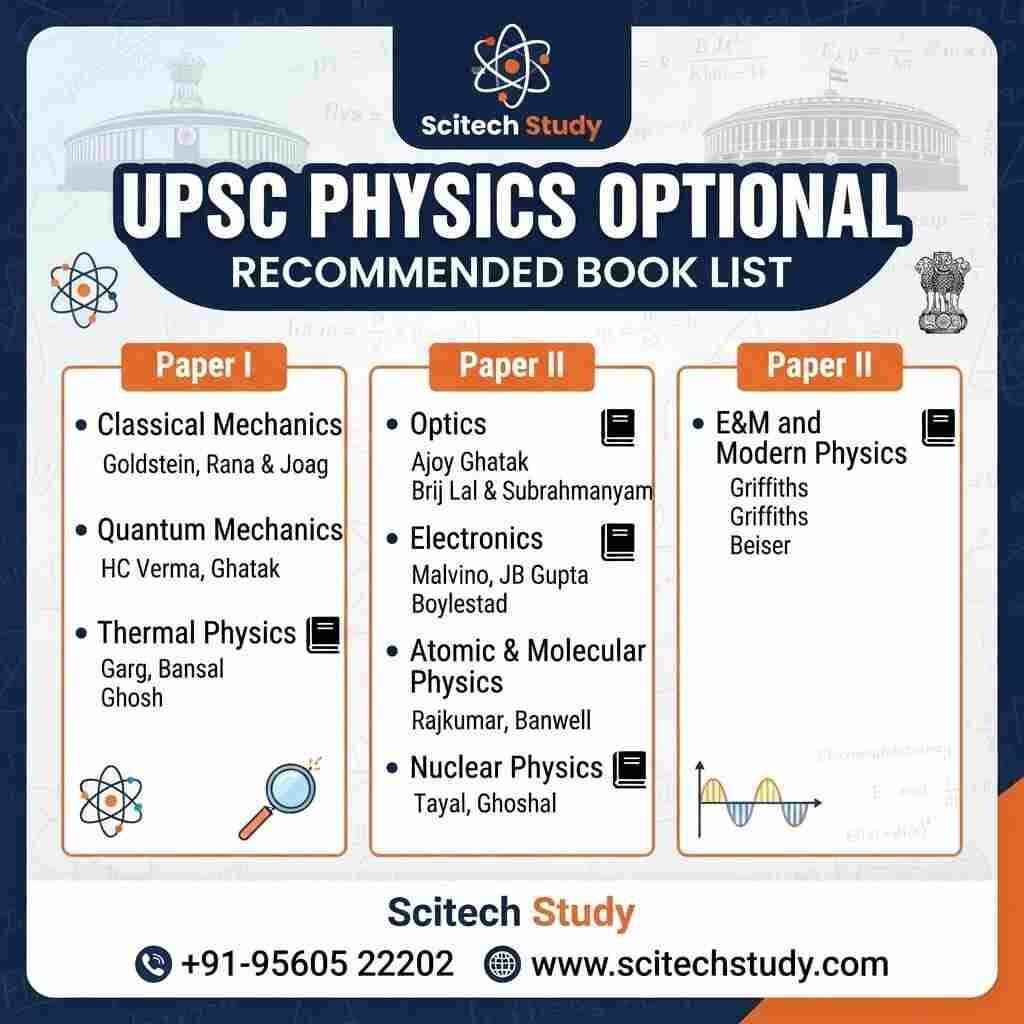
Master the Mains Syllabus: The Ultimate UPSC Physics Optional Book List Curated by Scitech Study
Selecting Physics as an optional subject for the Civil Services Examination is one of the most rewarding decisions an aspirant can make, provided they navigate the vast syllabus with the right resources. Building an effective preparation strategy begins with identifying an authoritative UPSC Physics Optional Book List that balances core theoretical foundations with rigorous numerical problem-solving. At Scitech Study, our experienced faculty has meticulously crafted a standard UPSC Physics Optional Book List to save candidates hundreds of hours of trial and error, ensuring they study strictly what is relevant for Paper I and Paper II. By grounding your preparation in standard reference texts alongside structured classroom guidance, you can comfortably master complex derivations, score high marks in numericals, and turn your physics optional into your highest-scoring paper in the UPSC Mains examination.
The Strategic Importance of a Curated Book Selection
Physics is a purely objective subject where answers are either mathematically right or wrong. Unlike humanities optionals where marks depend heavily on subjective evaluation, a well-derived physics answer with accurate assumptions, neat diagrams, and correct numerical units is guaranteed top marks. Having an organized UPSC Physics Optional Book List is the foundational step to avoid the trap of referring to too many bulky textbooks for a single topic.
Relying on a streamlined reading inventory allows you to focus on high-yield exam areas and master the exact derivation formats required by UPSC evaluators. When you narrow down your sources to one or two standard reference books per topic, you gain the time needed for repeated revisions, formula memorization, and rigorous previous year question (PYQ) practice.
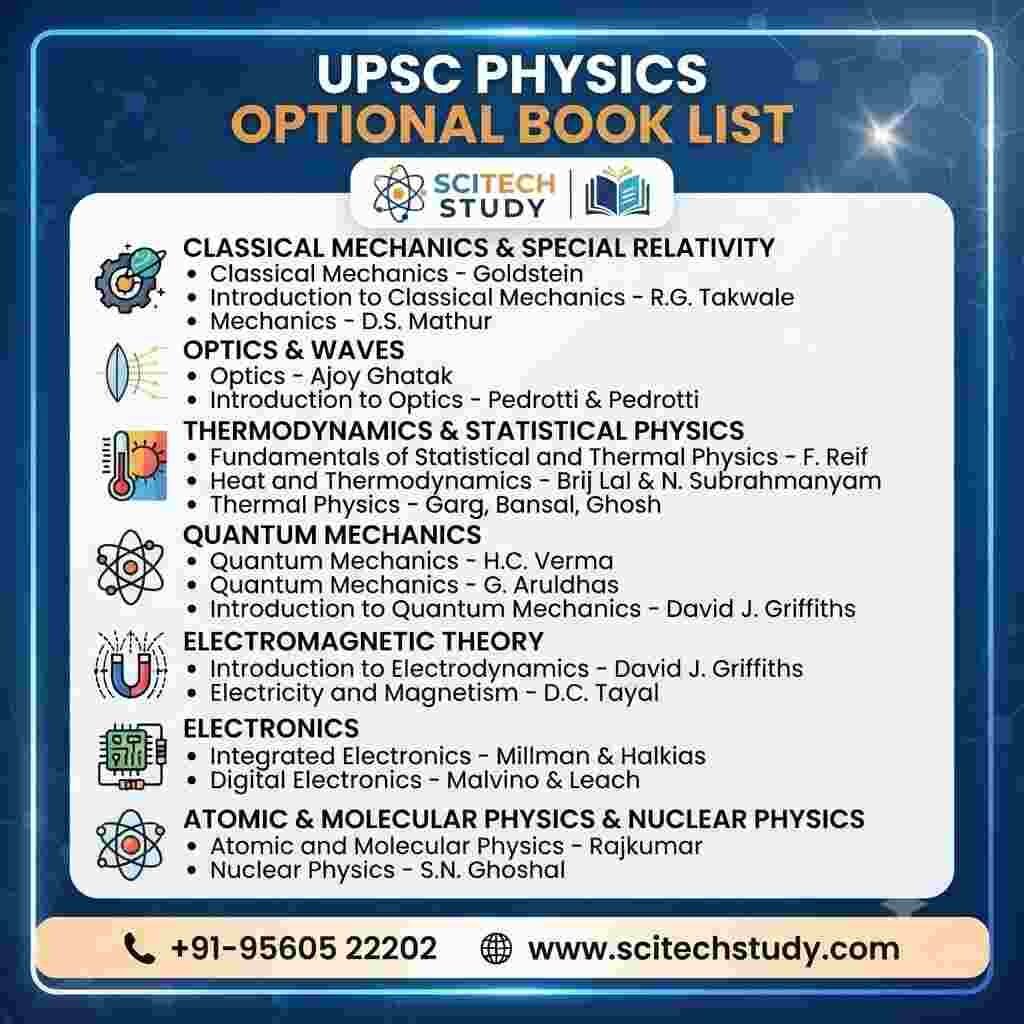
Expert Insights on Paper I: Recommended Textbooks
The essential Paper I section of the UPSC Physics Optional Book List focuses on classical mechanics, wave optics, electrodynamics, and thermal physics. Here are the premier references that form the backbone of your preparation:
Mechanics & General Properties: Classical Mechanics by J.C. Upadhyaya or Herbert Goldstein for advanced Lagrangian and Hamiltonian formulations, along with Mechanics by D.S. Mathur for rotational dynamics and central forces.
Waves & Geometrical/Physical Optics: Optics by Ajoy Ghatak is the gold standard for wave optics, interference, diffraction, and polarization, while A Textbook of Optics by Brijlal and Subrahmanyam serves as a great companion.
Electricity & Magnetism: Introduction to Electrodynamics by David J. Griffiths is indispensable for vector calculus, Maxwell’s equations, and electromagnetic boundary conditions.
Thermodynamics & Statistical Physics: Heat and Thermodynamics by Mark W. Zemansky and Richard H. Dittman, paired with Statistical Mechanics by B.K. Agarwal and Melvin Eisner.
Master Paper II: Modern Physics and Electronics
When building your UPSC Physics Optional Book List for Paper II, you should select titles that present mathematical proofs clearly for microscopic phenomena, modern quantum theory, and solid-state devices:
Quantum Mechanics: Quantum Mechanics: Concepts and Applications by Nouredine Zettili for worked-out numericals, alongside Introduction to Quantum Mechanics by David J. Griffiths.
Atomic & Molecular Physics: Physics of Atoms and Molecules by B.H. Bransden and C.J. Joachain, or Atomic and Molecular Spectra by Raj Kumar for laser physics and spectroscopy.
Nuclear & Particle Physics: Introductory Nuclear Physics by Kenneth S. Krane and Nuclear Physics by S.B. Patel for radioactive decay models, nuclear models, and elementary particles.
Solid State Physics & Electronics: Introduction to Solid State Physics by Charles Kittel for crystal lattices and band theory, coupled with Electronic Devices and Circuit Theory by Boylestad and Nashelsky.
How to Effectively Utilize Your Standard Reference Titles
Even with a complete UPSC Physics Optional Book List, knowing how to process these books determines your final output on the exam sheet. Aspirants must approach their reading with a structured method:
Step 1: Syllabus Mapping: Cross-check every chapter against the official UPSC notification. Read only the specific syllabus sub-topics rather than reading entire textbooks cover-to-cover.
Step 2: Note-Making for Derivations: Create concise, handwritten formula sheets and standard derivation steps for every single chapter to facilitate quick revision before test series.
Step 3: Solve In-Text Examples: Work through all solved numerical examples provided in textbooks like Griffiths and Zettili, as UPSC frequently adapts these standard problems.
Step 4: Answer Presentation Practice: Accompany your calculations with neatly sketched block diagrams, circuit equivalents, and ray diagrams with proper labelings.
Streamlined Modules and PYQ Workbooks at Scitech Study
While standard textbooks are essential for building theoretical depth, organizing notes across eight distinct sub-disciplines can become exhausting. Our mentors understand how to compress a wide UPSC Physics Optional Book List into concise, readable study booklets and categorized previous year question workbooks.
Every theoretical booklet in our classroom program is paired with a solved workbook containing over 20 years of categorized UPSC previous year questions. This bridge material ensures that you can immediately apply concepts from standard references to actual mains questions without wasting valuable study hours.
Hybrid Mentorship and Structured Guidance
Civil Services preparation requires balanced time management between your optional subject, General Studies, and essay papers. To make quality coaching flexible and accessible, Scitech Study operates on a dynamic hybrid model.
Students can attend live, interactive physical lectures in Chandigarh or access high-definition recorded archives and online doubt-clearing sessions from anywhere. This hybrid ecosystem allows aspirants to review complex derivations, verify solutions, and get personalized answer copies evaluated by experienced faculty on a regular schedule.
Focused Campus Environment for Serious Aspirants
Mastering abstract quantum mechanics and electrodynamics requires an atmosphere free from noise and distractions. Our Chandigarh learning center features modern multimedia classrooms, dedicated discussion areas, and a specialized scientific reference library stocked with all essential reference texts.
Located in a prominent educational hub, our facility is easily accessible to students from Chandigarh, Mohali, Panchkula, and outstation aspirants. Comfortable student accommodations, reading rooms, and transport links are available within walking distance of the campus.
Proven Track Record of Success in Science Optionals
Over the years, Scitech Study has built a solid reputation for delivering exceptional results in competitive technical examinations. We focus heavily on understanding how to apply your UPSC Physics Optional Book List under exam hall conditions, empowering aspirants to tackle unpredictable papers with complete confidence.
Enrolling in our mentorship program gives you a disciplined daily framework, regular answer-writing evaluations, and direct access to senior educators. We ensure you not only read the right books but also master the art of scoring maximum marks in the UPSC Mains.
Frequently Asked Questions (FAQs)
Q1: Should I read every single book mentioned in the syllabus list from cover to cover?
No. You should strictly read only those sections and chapters that match the topics mentioned in the official UPSC syllabus.
Q2: Are foreign author textbooks like Griffiths and Zettili necessary for numericals?
Yes, foreign author books like Griffiths for Electrodynamics and Zettili for Quantum Mechanics provide conceptual clarity and standard numerical problems that directly match UPSC question patterns.
Q3: How many hours should I dedicate daily to physics optional preparation?
Aspirants should ideally dedicate 4 to 5 hours daily to their physics optional, dividing time equally between learning theoretical derivations and solving numerical problems.
Q4: How does Scitech Study help students manage such a vast reading list?
Scitech Study provides synthesized study booklets, formula cheat sheets, and categorized PYQ solutions that compress voluminous reference textbooks into high-yield, exam-oriented study material.
Contact Scitech Study and Start Your Preparation Today
Admissions for our specialized UPSC Physics Optional foundation and answer-writing batches are now open. Batch sizes are kept strictly limited to ensure individual mentorship and detailed copy evaluation for every aspirant.
Reach out to our academic counseling desk to book a demo session, collect course brochures, or receive personalized preparation advice:
📍 Campus Address: Scitech Study, SCO 35, Sector 16D, Chandigarh – 160015
📞 Official Contact Number: +91-95605 22202
📧 Academic Email Address: scitechstudyeasy@gmail.com
🌐 Official Web Portal: www.scitechstudy.com
Do not leave your optional preparation to unstructured self-study or unverified notes. Partner with Scitech Study, master the recommended UPSC Physics Optional Book List, and build the solid foundation you need to secure a top rank in the Civil Services Examination!



